

How We Took Canada
A Private Account of the Northern War • A Proofs of Empire Story

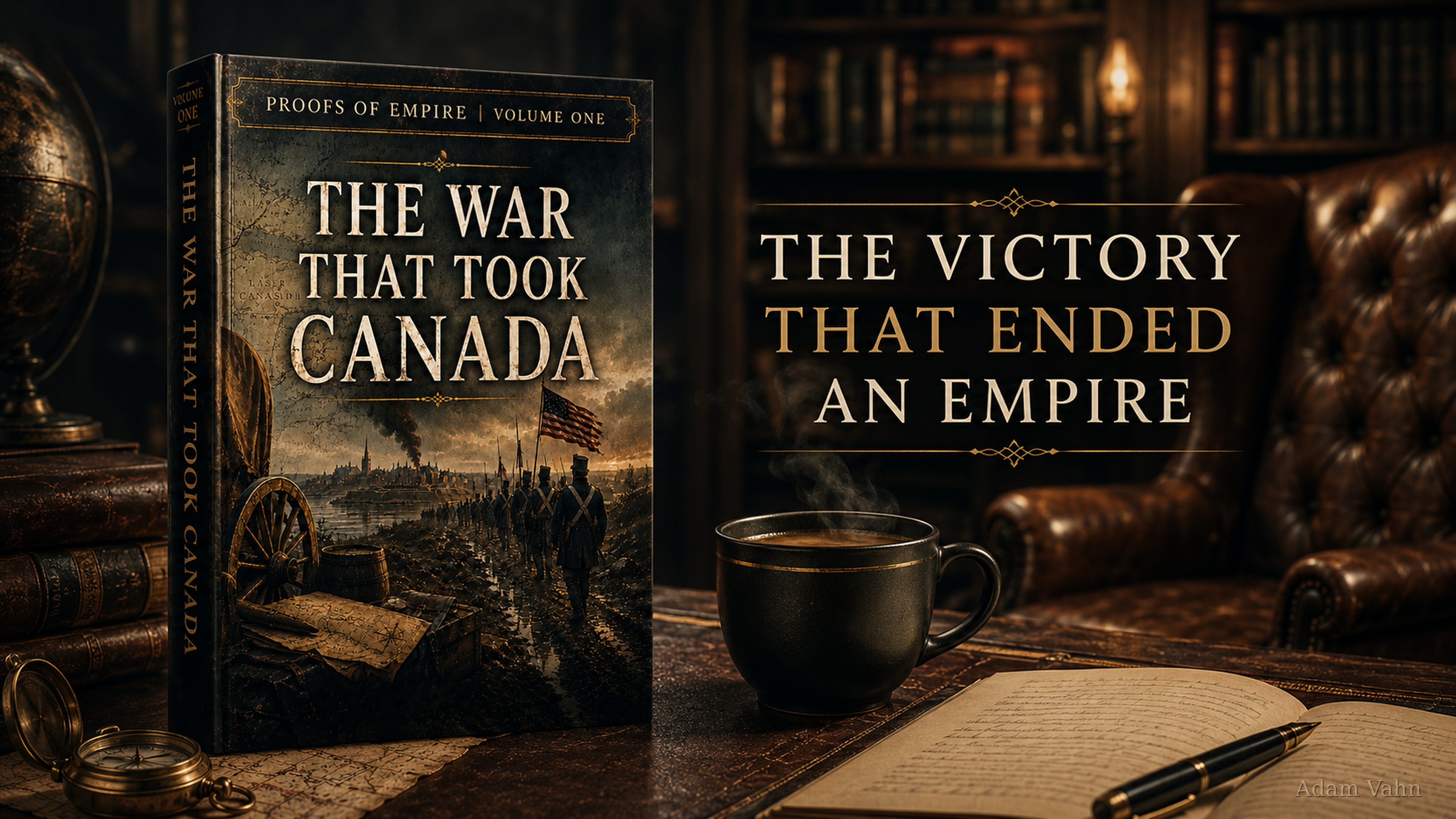
A Proofs of Empire Story
A note before you begin. This is a standalone story set in the world of my alternate-history series, Proofs of Empire. You do not need to have read the novels to read it. It begins in the War of 1812 as it actually happened, the real defeats at Detroit and Queenston, and then, at a single point, it forks. The narrator is a senior official who lived both versions and can no longer tell you which one is the dream. If you like what the series does, this is a clean way in.
I am told that a man setting down the truth late in life should begin with an apology, and I have none to give. I was there for the decision, and I signed the papers that carried it, and I have outlived nearly everyone who could contradict me. What follows is not the war the schoolbooks teach. It is the war as it was chosen, in rooms with bad light and worse coffee, by men who did not know they were choosing anything at all.
My name will mean nothing to you. I was an assistant secretary in the War Department, which is to say I was the man who read what the Secretary had no time to read and remembered what the President preferred to forget. I kept the ledgers of an army that did not yet deserve the name. In the spring of 1812 that army numbered fewer than seven thousand regulars, most of them unpaid, scattered along the coast in forts that faced the wrong ocean.
We declared war on the largest navy in the world with that. I want you to sit with the arithmetic of it, because the arithmetic is the whole story, and everything else is decoration.
The Summer We Lost
You have been taught that the War of 1812 ended in a draw, that we burned a little, they burned a little, and both sides went home to call it a victory. That is the merciful version. I lived the other one.
In August, General Hull crossed into Upper Canada at Detroit with an army that outnumbered every British soldier west of Montreal, and then he stopped. He had no supply line he trusted. His militia would not follow him past the point where the law said they could refuse. He sat in the heat and read letters about Indians gathering to his rear, and his nerve went out of him like water from a cracked barrel. When Brock came up the river with a force half his size and a great deal of noise, Hull surrendered the fort, the town, the army, and the entire territory of Michigan without firing the guns he had. I read the dispatch three times. I remember thinking that we had not been beaten. We had simply failed to arrive.
At Queenston in October it was worse, because at Queenston we very nearly won. Our men took the heights. Brock himself fell leading the counterattack, shot through the chest climbing a hill he did not need to climb. For an afternoon the door to Canada stood open. And then the New York militia, drawn up on our own bank of the river, in sight of their countrymen being cut apart across the water, declared that their enlistment did not oblige them to leave the state of New York, and they stood there, and they watched, and they went home.
I have been asked many times since whether I hated those men. I did not. They were farmers who had been promised a short walk and given a slaughter, and no one had fed them, and no one had told them why. You cannot ask a man to die for a plan he can see is broken. The failure was not in the militia. The failure was in every desk between the frontier and mine, and mine was one of them.
We had not been beaten. We had simply failed to arrive.
By December the northern campaign was a rumor of itself. Wilkinson could not move an army down the St. Lawrence because there was no road that would carry the wagons and no magazine at the far end to receive them if there had been. Food rotted in Albany while men starved at the border. Powder arrived wet. Boots arrived in the wrong sizes, in the wrong season, in numbers that suggested a clerk somewhere had confused a requisition for shoes with a requisition for something else entirely. We had a continent of will and not one honest mile of preparation, and the two do not add. This is the first thing I learned and the last thing anyone in that government wanted to hear.
I remember a night in the department that winter when a report came in listing the strength of a regiment on the border, and beside the number of men fit for duty was a smaller number, the men who still had shoes, and a smaller number again, the men who had eaten that day. Three columns, each one shorter than the last, and I understood that the third column was the only one that fought, and that we had spent a year arguing about the first. A nation debates its will. An army lives on its third column. The distance between those two facts is where the men died, and no one at the level where I worked had ever been made to see the third column at all, because it does not appear in a speech, and everything that reaches a President’s desk has already been through the machinery that turns the third column into the first.
The Memorandum
Now I must go back, because the pivot of everything I am about to tell you was already five years old by the time Hull surrendered, and almost no one noticed it happen.
In the winter of 1807, after the Chesapeake affair, when a British frigate fired on one of our ships in our own waters and took our sailors off her deck, the country wanted war. It wanted it the way a fever wants to break. And in that heat a memorandum crossed my desk, written by a colonel of engineers whose name you would not know, arguing that the republic could not fight the war it wanted with the army it had, and that the honest response to an insult was not a speech but a road.
He had done the sums. He knew how many barrels a wagon carried before the axle split, and how many miles it made in a day on a good surface and how many on a bad one, and how much a barrel of flour cost in Albany against what it cost delivered to the Niagara frontier, which was a different and much larger number. He knew that whoever held the Great Lakes held the whole northern country, and that holding the lakes was a question of carpenters and rope and seasoned timber, not of glory. He proposed that we spend the years of peace we were likely to get building the unglamorous things: depots, roads, lake craft, a corps of regulars large enough to matter and drilled long enough to hold. He proposed, in short, that we prepare.
It was the least popular document I ever handled. A standing army frightened the republic more than any British frigate. Men who had made the Revolution had made it partly against exactly such an army, and they were not wrong to fear it. The memorandum sat in a drawer for a season while the fever cooled, and it would have died there, as such things do, except that the President read it.
The honest response to an insult was not a speech but a road.
I was in the room when he read it, and I will tell you the truth of that moment, because it is the hinge on which two worlds turn. He did not like it. He understood, better than the colonel did, what such a machine would do to a republic once it existed, that you cannot build an instrument of that power and expect it to sit idle, that an army raised to defend a border will in time discover borders it would prefer to move. He said as much. And then he signed the authorization anyway, because the alternative was to be humiliated again the next time, and a man responsible for a nation cannot govern from principle alone. He chose the lesser fear. Every man does, in the end. That is how the great crimes get their paperwork.
Five Years of Mud
Here is where the account leaves the world you know.
I want to be precise about the deviation, because it was not dramatic and it did not feel like history while it happened. No battle turned. No great man made a speech. What happened is that for five years, from 1807 to 1812, a small number of men did dull work without stopping, and the country let them, and that was the entire miracle.
We surveyed the routes north from Albany and we built the roads that Wilkinson had lacked, corduroyed through the swamps, graded on the grades, with bridges rated by weight and weather so that a quartermaster three hundred miles away could know to the wagon what a given crossing would bear in March. We stacked magazines at intervals a loaded column could actually reach in a day, so that an army moving north would find food waiting rather than carry its own hunger with it. We drilled the regulars through three winters until they could form and fire and march in the dark and hate their officers in the particular way that means they will follow them. And on the lakes we built, quietly, in yards the newspapers ignored, the vessels that a war for the north would turn upon.
The colonel oversaw much of it, and I oversaw him, which is to say I found the money and hid it under names that would not alarm the Congress. Coastal relief. Internal improvement. The survey of public lands. A government that will not vote for an army will vote for a road, if you let it keep the word road. I learned in those years that the whole art of preparing a republic for what it claims not to want is the art of calling things by their harmless names. I was good at it. I am not proud of that, but I was good at it.
The whole art of preparing a republic for what it claims not to want is the art of calling things by their harmless names.
Men complained, of course. A depot is expensive and it does nothing, which is exactly its virtue and exactly what makes it hard to defend before it is needed. Contractors robbed us, because contractors always rob you, and the trick is not to stop the theft, which is impossible, but to build a margin for it into the sums so that the army eats anyway. I signed for barrels I had not counted, against every instinct, and hated it, and learned that hating a necessity does not excuse you from it. There was an officer under the colonel, a hard man named Pike, who would not sign for anything he had not weighed himself, and who therefore held up a supply train for a full day at Sackets Harbor over a discrepancy of eleven barrels. I was furious with him at the time. I understood him later. The eleven barrels were real. They were always real. That was the whole of his argument, and he was right, and being right cost the rest of us a day and cost the contractor his contract, and the army that reached the border a year later reached it fed, in part, because a difficult man had refused to be reasonable.
I will tell you the smallest thing I remember from those years, because it has stayed with me longer than any battle. In the spring of 1810 I rode north to see the work myself, having grown tired of knowing the country only through the reports that crossed my desk. At a crossing on the Black River I found a bridge the colonel’s men had built, and a sergeant standing beside it with a painted board that gave its rating: so many wagons an hour, at such a weight, in such a season. I asked him whether anyone ever read the board. He said the teamsters read it, because a teamster who ignored it lost his wagon in the river, and a teamster who lost his wagon in the river lost his contract, and so the board was obeyed in a way no order from Washington had ever been obeyed. I rode on thinking that we had at last found the one form of authority the republic could not argue with, which was the authority of a thing that would drop you into cold water if you were wrong about it. That is what we had built. Not an army, yet. A country that could no longer lie to itself about weight.
The Declaration in Ink
When the war came in June of 1812, it came to a different country than the one that had failed at Detroit in the world I described to you. I am aware how strange that sentence is. I can only tell you that both of those summers are real to me, the one we lived and the one we might have, and that I no longer trust anyone who is certain which is which.
The declaration was the same. The votes were close, the speeches were poor, the reasons were a tangle of impressment and honor and land that no two members could have agreed upon. But the army that received the order was not the army of the old summer. It had roads under it. It had food ahead of it. It had three years of drill in its hands and officers who had spent those years learning the ground.
Hull crossed at Detroit again, and this time the supply he trusted was there because it existed, and when the letters came about Indians gathering to his rear he had a garrison and a magazine and a line of retreat that was also a line of reinforcement, and he did not break. Brock came up the river with his force half the size and his great deal of noise, and the noise did not work on men who had been fed, and Detroit held. That is the entire difference. Not courage. Detroit held because a road that did not exist in one world existed in the other, and an army that could feed itself does not frighten.
The lakes opened next, because the vessels built in the ignored yards were on the water before the British could match them, and once the lakes were ours the whole northern country became a problem of movement, and movement was the one thing we had spent five years learning. Queenston, in this telling, did not depend on a New York farmer’s willingness to leave his state, because the men who took the heights were regulars with a supply line, and they held what they took, and the door to Canada that stood open for an afternoon in the world I lost stood open long enough, in this one, to march an army through.
Detroit held because a road that did not exist in one world existed in the other.
The Long Grind North
I will not give you the campaign in detail. There are men who can, and their accounts are in the archives, and they are mostly honest, which is its own kind of rare. I will give you the shape of it, because the shape is the argument.
An army that eats moves north along the St. Lawrence in the autumn and the winter, past Montreal, toward Quebec, grinding, unglamorous, unstoppable in the particular way that only logistics can be unstoppable. It does not win battles so much as it makes battles unnecessary. It arrives where it is not expected because it can, and it stays because it is supplied, and the enemy, who is fighting a much larger war against Napoleon three thousand miles away and cannot spare a single regiment more than he already has, does the arithmetic that we had refused to do for so long, and withdraws to Halifax, which is fortified, and which he can hold, and which is not Canada.
Britain did not lose the north in a battle. Britain lost the north to a spreadsheet. I say this without triumph. I helped make the spreadsheet, and I have had forty years to consider what it did.
Because the fighting, it turns out, was the easy part, and this is the thing no one who cheered the victory wanted to hear from me. When you take a country, you are left holding a country, full of people who did not ask to be taken and who do not become yours because a treaty says so. What followed the army was not glory. It was the oath rooms, where men swore allegiance they did not feel because the alternative was to lose their land. It was the claims registers, where the property of the departed and the disloyal was written into new hands with a legality that fooled no one and bound everyone. It was the slow, patient paperwork by which occupied ground becomes administered territory, and administered territory becomes, given a generation and a schoolbook, something a child will call his country without knowing what it cost.
Britain did not lose the north in a battle. Britain lost the north to a spreadsheet.
I should say a word about the people we took, because the accounts in the archives do not, and their silence is a kind of lie. The habitants of Lower Canada had no love for Britain, but they had less reason to trust us, and they were not the passive prize the newspapers imagined, waiting to be handed from one crown to another. They had a church, and a language, and a memory of two empires that had each promised them protection and each spent them, and they watched our oath rooms with the flat patience of people who have learned that every government arrives speaking of liberty and stays to collect taxes. The Indian nations of the lakes had watched even more closely, and with better cause, because they had fought their own war inside ours, made their own calculations about which ally would betray them slower, and discovered, as the paperwork closed over the country, that the answer had been neither. We did not take an empty land. We took a full one and wrote it empty, register by register, and the writing was the conquest, more than any battle was.
The Treaty, and What It Taught Us
The Treaty of Portsmouth made the conquest legal and permanent, and I was present for parts of the negotiation, and I can tell you that the hardest word in the whole document was the smallest one. Not the boundaries. Not the indemnities. The word cede. To cede a province is to agree that it was ever the other man’s to give, and the British negotiators clung to that word like a plank in a wreck, because it preserved the fiction that they had lost something they owned rather than surrendered something they could no longer hold. We let them have the word. It cost us nothing. We had the land.
And here is the part I have waited the length of this account to tell you, because it is the only part that finally matters. When it was done, when the north was ours and the treaty signed and the maps redrawn, the men who had run the war did not sit back satisfied. They looked south and west, at Texas, at the whole expanse of a continent that Spain and then Mexico held with even less real strength than Britain had held Canada, and they said, in effect: we know how to do this now. We have the roads. We have the depots. We have the men. We have the paperwork. We have the proof.
That was the word they used. Proof. As though the conquest of a people were a theorem, and the only question remaining were what else it might be used to demonstrate. I heard a senator say it at a dinner, that the northern war had been a proof of the republic’s capacity, and I watched the table nod, and I understood in that moment that we had built something that would not stop, because we had taught ourselves that it worked, and a nation that has learned it can do a thing will always, eventually, find a reason to do it again.
The conquest of a people, treated as a theorem, and the only question what else it might demonstrate.
The colonel who wrote the memorandum did not live to see Texas. The President who signed it did, and he said nothing that I ever heard, and I have wondered whether his silence was the silence of a man who got what he feared or the silence of a man who no longer remembered fearing it. I am the last one who knows, and soon I will not know either, and that is why I have written this down.
What I Would Have You Understand
Do not read this as a confession that we should have stayed weak. I lived the summer we lost. I read the dispatch from Detroit three times. I know exactly what unpreparedness costs, and it is paid by farmers who were promised a short walk, and I will not pretend that the road I helped build was not also, at Queenston, the thing that kept a certain number of them alive. That is the trap of the whole business. The preparation that prevents a defeat is the same preparation that enables a conquest. They are not two machines. They are one machine, and it does not care which you ask of it, and the day you build it you have already, in some sense, decided.
The deviation that set our timeline on its course was not a battle and not a great man. It was a memorandum in a drawer, and a tired President who chose the lesser of two fears, and five years of men doing dull work in the mud without stopping. That is how empires actually begin. Not in ambition. In competence, applied to a fear, and then never put down.
I have called this a private account, and I mean to keep it private a while yet, because the country is not ready to be told that its founding virtue and its founding crime were the same act. Perhaps it never will be. But it happened, and I was there, and I signed the papers, and someone, someday, should know that the road came first.
The rest, as they say, is only history.
If this held you, the series goes further.
“How We Took Canada” runs parallel to Volume I of Proofs of Empire, the story of the republic that did the unglamorous work first, took Canada, and then had to keep it. Five volumes carry the consequence from 1812 to the 1870s: occupation, rebellion, negotiation, and the long westward habit that one successful conquest set in motion.
Volume I, The War That Took Canada, is on Amazon and free in Kindle Unlimited: AMAZON
Everything else, the full series, new stories like this one, and how the books get made, lives at AdamVahn.com. Subscribe there and I will send the next installment straight to you.
Adam Vahn • Iron Road Press