

Routing Is Not Refusal
On the clean words that carry cruelty, and the novel I built to stand inside one of them.

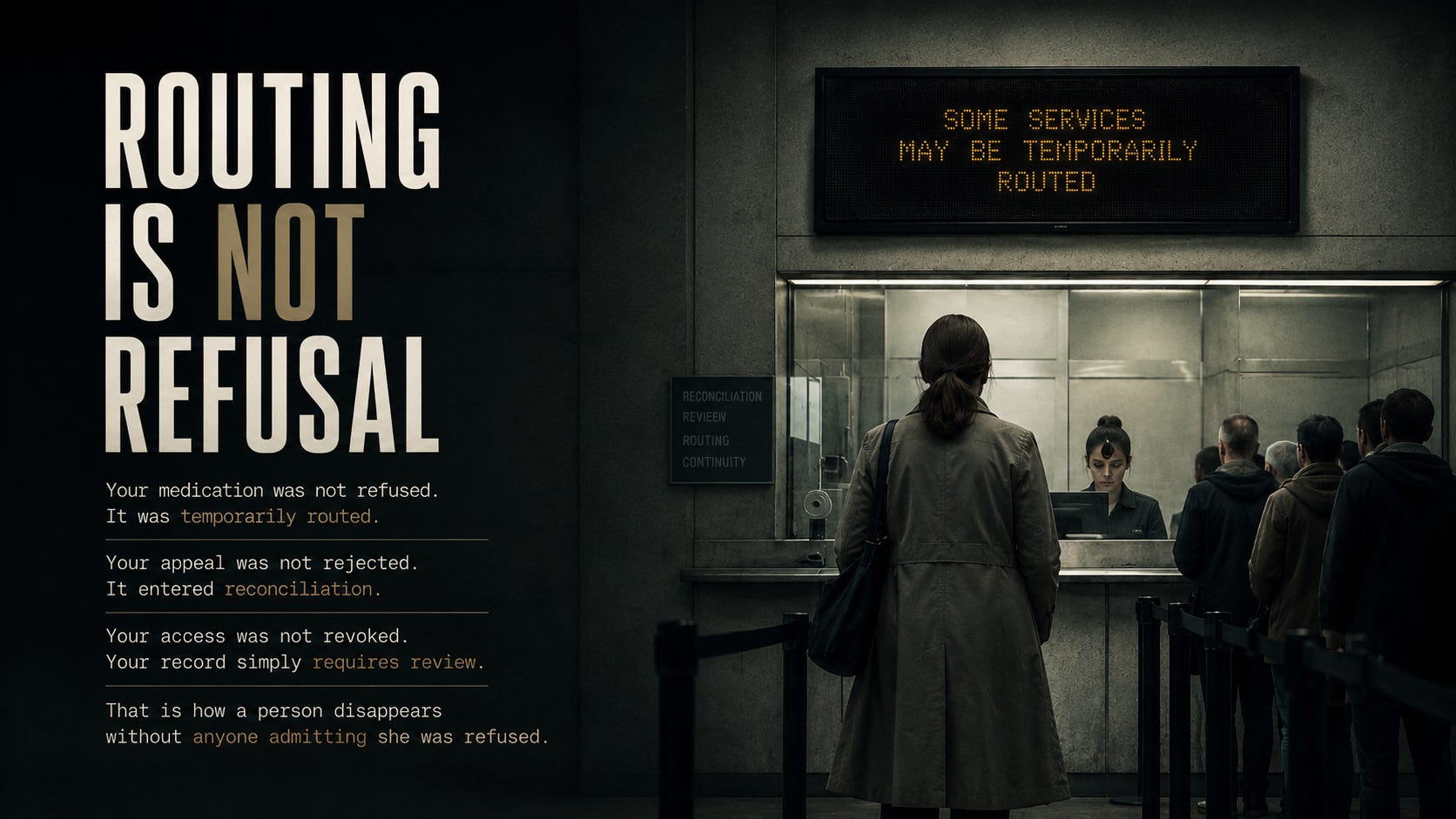
The counter is laminate, worn pale where a thousand wrists have rested. She sets hers down because the sign tells her to, palm up, the way you offer a vein. The reader ticks. It does not beep. The good machines stopped beeping years ago. A beep is an accusation, and accusations generate complaints, and complaints generate paperwork, so the device glows instead, a soft amber the color of a signal caught between two intentions. The clerk behind the glass does not look up from her screen.
“Some services may be temporarily routed,” she says. “Thank you for your patience.”
The woman is not refused her medication. Nobody refuses her anything. That is the part I could not put down. There is no officer, no stamp, no door swung shut in her face. There is a sentence with no author, a queue she has just entered without applying, and the word temporarily, which is the most expensive word we own, because it asks you to wait and declines to say for how long.
I wrote an entire novel to stand at that counter for a while. Here is why.
The cruelty has always traveled first class
Cruelty does not arrive in the language of cruelty. It learned long ago that the rough word draws attention and the smooth one does not. So it dresses. It books a quiet seat. It calls itself resettlement and separate development and voluntary departure. It calls itself continuity and resilience and, when it is feeling modern, routing. The euphemism is not a coat of paint over the machine. The euphemism is load-bearing. It is the part that lets a decent person at a desk do the indecent thing and go home believing the day was ordinary, because every sentence she signed was, on its own, reasonable.
That is the trick worth understanding. The horror in the story I wanted to tell is not that someone evil seizes the controls. It is that no one does. The system never removes a citizen. It routes the citizen’s rights around the citizen and thanks her for her patience. I find that more frightening than any villain, because I cannot locate the moment it becomes a crime. Show me the law it breaks. There isn’t one. Every step is legal, documented, and polite, and at the bottom of the stairs there is a person who no longer exists in any way the network can read.
The collapse arrives politely, one denied request at a time.
I did not invent the technology
This is the part people want to argue with, and the part I cannot give them. The surveillance in the book is not borrowed from science fiction. It is borrowed from the census, the credit score, the loyalty card, the convenient login, the data we have already agreed, a hundred times, with a thumb, to share. The state in these pages does not spy. Spying is effortful and deniable and expensive. It merely merges. It reads what was already lying around, correlates what we volunteered, and presents the result as a service. I added almost nothing. I changed almost nothing. I asked one question and then refused to look away from the answer: what would these things do if we simply let them keep doing what they are built to do?
I did not invent the country either
I want to be careful here, because the lazy version of this essay flattens history into one undifferentiated warning, and that is its own dishonesty. These cases differ in scale, in intent, in aftermath. They are not interchangeable. What they share is a grammar.
In 1967, in Afroyim v. Rusk, the Supreme Court held that citizenship cannot be stripped from you against your will. In 1927, in Buck v. Bell, the same Court approved sterilizing a woman it deemed unfit, and that ruling has never been expressly overturned. More than sixty thousand Americans were sterilized under state law, a practice that ran into the 1970s, inside living memory, with forms and signatures and a clinical word for each one. Britain spent decades welcoming the people it later could not find records for, and the Windrush scandal is what we named the finding-out. In Assam, a citizens’ register published in 2019 left roughly 1.9 million people off the rolls. In the Dominican Republic, a 2013 court decision reached back through generations and quietly unmade them.
None of this required a monster. It required clerks, statutes, and a vocabulary that let everyone involved describe the work as administration. The histories are public. They were filed correctly and available to anyone, the whole time, which is the only thing I generalized.
The most dangerous person in the building
My narrator is a reconciliation clerk. She is good at her job. I built her that way on purpose, because the most dangerous person inside a machine like this is not the architect and not the zealot. It is the competent one at the window who keeps a clean file, learns the soft forms, never gives the system a reason to look twice, and protects her own family by operating the apparatus that takes someone else’s. She is not a hero. She does not win. She is ordinary, which is the worst thing I can say about her and the truest.
I gave the cruelty clean words on purpose, because that is how it has always moved. If the language in the book ever made you comfortable for a paragraph, even once, that was the design, and I am sorry, and I am not.
A stack of bricks is not a wall
I do not think we are standing in the country I wrote. I did not build it because I believe it is coming. I built it because every brick of it is already made, and stacked, and for sale, and because the distance between a stack of bricks and a wall is shorter than we like to tell ourselves. It is the width of a few reasonable-sounding decisions, made by frightened people with something to lose.
The protection against that walk is not a machine and never was. It is the person who knows what to do when the system says no. The neighbor who keeps the paper record by hand. The clerk who, one morning, declines to route a human being around herself and lets the consequence land on her own desk instead.
I wanted to stand in that distance for a while, and I wanted you to stand there with me. Then I wanted to ask the one question the whole book is built around. You already know it. I am not going to insult you by answering it for you.
• • •
Routing Is Not Refusal is the nerve that runs through both of my novels. Wild Type is the literary dystopia this essay describes: a clerk, a grandmother who refused registration, and a family record with one gray square left to fill. The Systems Nobody Controlled is the thriller version of the same question: an entire country discovering that the override button exists and nobody can reach it in time. Both are out now from Iron Road Press. Links below.
The Systems Nobody Controlled (Amazon)
Wild Type (Amazon)