

The Letter He Could Not Send
Proofs of Empire: Parallel Stories, No. 1 · A companion to The War That Took Canada

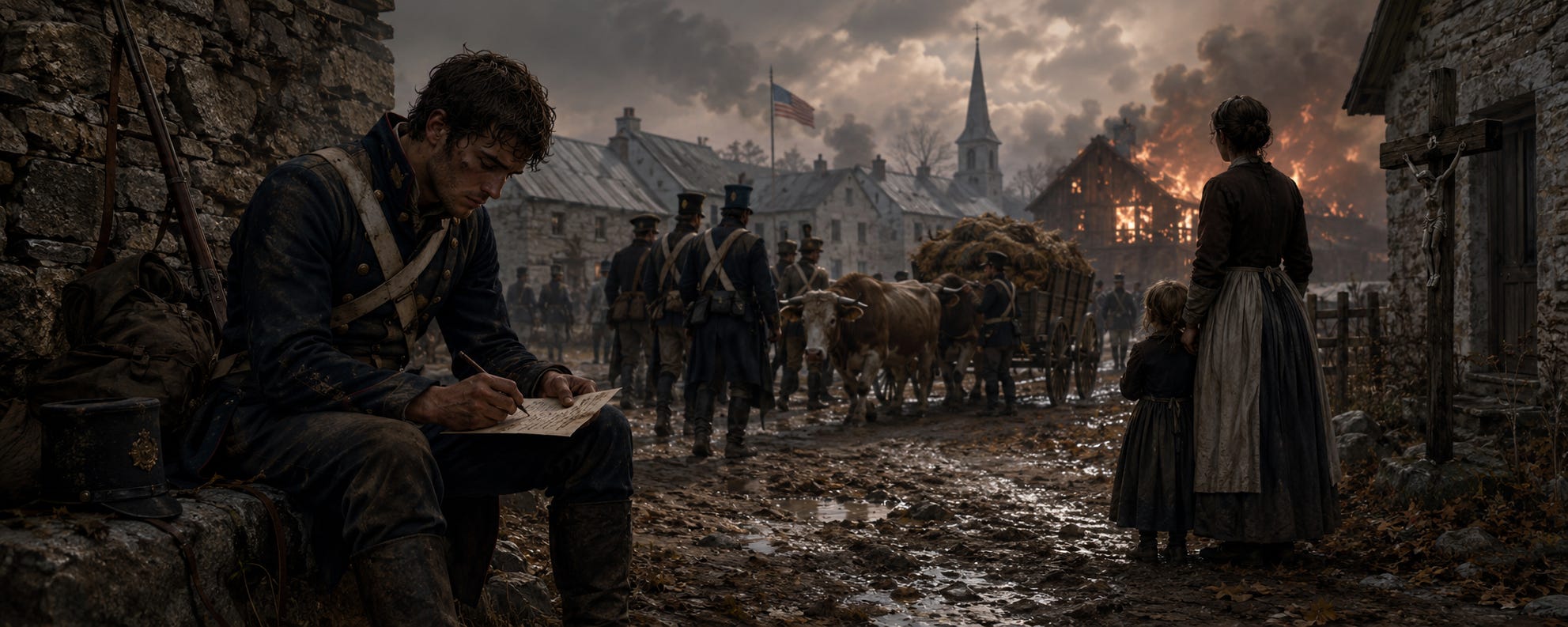
Camp near the Richelieu River October 23, 1813
Dear Father,
I am writing to you because I cannot write this to Ruth.
That is a shameful way to begin, but shame has become an ordinary article here, no scarcer than mud and no more remarked upon. I have written to Ruth every Sunday since we crossed north. In those letters the weather is cold but bearable, the food plain but sufficient, and the army forever one clean march from the thing it was raised to do. I tell her the British are drawing back and Montreal cannot stay beyond our reach through the winter. Every sentence is true. Set them side by side and they make a lie, and I have grown skilled at building it, board by board, the way you taught me to raise a fence so straight no one thinks to test it.
You once told me a man could mislead another without ever speaking falsely. At the time I thought you meant the traders who came through Cooperstown in spring, or the deacon asking after roof money with his hat already in his hand. I did not know a husband could do the same by describing only the parts of his day that will let his wife sleep.
Ruth still believes I am the man who left in April, when the ice had just gone off Otsego. I do not know whether that man is dead, but I know he would not recognize the thoughts that keep me company now. He believed fear would arrive during battle, announce itself plainly, and leave when the firing stopped. He thought courage was only the space between hearing the order and obeying it. He was wrong on both counts. Fear does not leave. It takes quarters. It sleeps behind the ribs and rises before the drum, and a man can carry it through a whole day of ordinary work without his hand shaking once.
The officers say we are making progress, and they have maps to prove it. A red line marks our road up from the lake. Black squares show the depots. Blue pencil shows the river. When the general lays his finger on the paper, the whole campaign looks no larger than the cloth on your Sunday table. The country is smooth. Villages are only names. Hills are strokes of ink. A bridge is a short pair of lines drawn close together. On the ground, every one of those lines has a price, and someone here is always paying it.
This is strange country, Father. At home a farm sits square to the road and the road runs straight to the next man’s square. Here the farms lie in long ribbons running back from the river, each one narrow as a lane and deep as a day’s walk, so a whole parish shares the same water, the same church bell, and, I think, the same suspicion of us. The houses are stone, whitewashed, roofs pitched steep and bright against the frost. At the crossroads stands a tall wooden cross with a little tin Christ nailed to it, rusting at the feet, and the men take off their hats going past it though not one of them could say why. Every gatepost and every scrap of paper tacked to a door is lettered in French, and I cannot read a word of it. I had not known a country could refuse you simply by the shape of its writing.
The road north of Champlain was cut by men who had never seen what an autumn rain does to clay. We sank to the ankle, then to the calf. Flour barrels split after being rolled over stone, and the meal drank the mud and was lost. One gun lost a wheel and sat beside the road two days while the whole column filed past it as though it were a dead horse nobody would own. The quartermaster called the delay regrettable. That word marched with us longer than the gun did.
There is a private in our mess named Amos Bell. He is nineteen, and says almost nothing unless you ask him about clocks. His father keeps a shop in Albany and repairs them, and Amos can name every wheel in a tall-case movement the way our old minister could name the sons of Jacob, in order, without drawing breath. Three nights ago we stood picket together near an abandoned farm, one shutter banging in the dark, and to fill the time he told me that a clock rarely fails because the whole machine breaks at once. One small tooth bends. One pin slips. Everything the clock does afterward is only the machine reporting that first injury, over and over, in a voice everybody has learned to trust.
I have thought about that ever since. Perhaps an army is a clock. We march because a clerk copied a figure, because a contractor swore a wagon would be waiting, because a colonel would not stand up in a warm room and say the bridge will not bear the guns. Each of those decisions is small enough for the man who made it to defend. Then the machine begins striking the wrong hour, and boys like Amos are sent out into the dark to set it right with muskets.
Yesterday we came into a village whose name I will not write. The houses stood close around a white church with a spire of bright tin. Most of the men were gone, north with the militia or into the woods I cannot say. Women watched us from the doorways with that steadiness a person keeps when running is no longer of any use. An old man stood by a stone wall with his hat in both hands. He did not curse us. I wish to God he had. Hatred would have made the whole business simpler.
Our orders were to search the barns for grain and stock that might feed the British. Captain Mercer read the order aloud, twice, and the wording was careful as a lawyer’s. Nothing to be taken without receipt. No dwelling entered save upon military necessity. Civilians to be used with firmness and restraint. Spoken in that dooryard it sounded almost Christian.
We took three oxen, twelve sacks of meal, and all the hay that had not gone to rot. Sergeant Vale sat at a kitchen table and wrote the receipts while a woman stood against the wall with a child gathered into her skirt. She asked what the paper was worth. Vale told her it might be presented to the proper American authority once the territory was secured. She asked where that authority might be found. He said it would be established. She asked, in careful English she must have saved for exactly such a day, whether the child could eat the paper until then.
No one answered her. Vale finished his column of figures, sanded the ink, and set the receipt on the table between them. He did not look proud. That matters to me, though I cannot fully say why. A cruel man would have been easier to carry. Vale is not cruel. In September he walked six miles back down a bad road to bring in a recruit who had dropped behind with fever, and carried the boy’s musket the whole way so the boy would not be charged for losing it. Yet he wrote the receipt, because the army wanted grain, and the army wanted grain because we had come to take the country, and the country cannot be taken without making its children hungry.
The oxen did not want to go. One pulled against the rope until blood came at its nose. Amos struck it across the flank to start it moving, then leaned in close and apologized to the animal under his breath, as though it might carry word of him.
I carried one sack from the barn myself. The woman watched me do it. Ruth would have read her face before I did. There was no grand anger in it. There was only arithmetic. She was counting what remained to her and dividing it into the weeks between now and spring. Perhaps that is what most of war looks like when you stand close enough: one person doing sums while another stands over them holding a gun.
We camped half a mile beyond the village. In the night a barn burned. I do not know who set it. Some said a lantern tipped in the straw. Others said local men had fired on the picket and one of ours put flame to the hay to drive them out. By morning the roof was down and the stone walls stood black and steaming against the white frost. Captain Mercer ordered an inquiry. It produced three statements, no two alike, and no man to answer for any of them. The report will say the barn was destroyed under uncertain circumstances. I saw the woman standing by the wreck of it after sunrise, the child on her hip, our receipt still in her fist.
Do not misunderstand me. The British have done worse, and I have seen the men who carry the proof of it south. We have found our own dead stripped of their shoes and left for the crows. Every army carries a bill of evidence against the other in its pack, and reads its own bill aloud each morning to explain what it means to do that afternoon. That is not the thing that troubles me. What troubles me is how short the road is between explaining a thing and being permitted to do it.
I took the bounty and marched because I believed the country had been insulted and struck at. British officers took Americans off American decks and called them subjects of a king they had crossed an ocean to be quit of. Congress spoke of honor. Our recruiting captain, standing on a barrelhead outside the meeting house, spoke of our homes and our firesides. Now I stand in another man’s home, in the smoke of his hay, and I am the one at the fireside.
The officers say the province must be conquered outright, because to leave it in British hands is only to guarantee the next war. They may be right. But if we stay, what have we become? Defenders who crossed the line and kept going? Liberators whose arrival has to be proven at the point of a bayonet before the liberated will credit it? I do not ask these things aloud. Questions carry rank here, the same as men do, and mine is too low to be heard.
A week ago we fought beyond a stand of maple near the river. It was no great battle, and no paper will print a line about it. A British light company and the parish militia tried to hold us off a narrow bridge long enough for their wagons to cross. I cannot give it to you in proper order. A man remembers a battle the way a broken window remembers the stone: all at once, in pieces, with the important part missing.
I remember the first volley making the maple branches jump as though a wind had struck only the tops. I remember someone screaming that we were firing high. I remember loading with fingers that seemed to belong to a slower and stupider man than myself. I remember Amos beside me, his mouth open and working, though no sound came from it that I could hear over the guns. I remember Sergeant Vale walking behind the line with no more hurry than a man crossing his own yard, touching each of us once between the shoulders, pressing us lower, spending no breath on words.
Then a man in a gray coat came out of the smoke. He was no farther from me than the old apple tree stands from your kitchen door. I saw his face as plainly as I see this page. He had reddish whiskers and one point of his collar turned under against his neck, and he was fighting a fouled musket that would not clear. I brought mine up.
He looked at me.
I fired.
Father, I have spent my whole life hearing men say that in a fight there is no time to think. That is another of the useful lies, and I want you to know it for one. There was time. Not much. Enough. Enough to see the turned collar. Enough to know he was as frightened as I was. Enough to understand that he had a father somewhere, or had once had one. Enough to lower the musket.
I did not lower it.
When the firing stopped I found him at the edge of the road. The ball had gone in below the chest. He was still living, and his hands moved against the wet leaves as though he had dropped something small and precious and meant to find it before he went. I knelt down thinking he wanted water. He did not want water. He kept saying a name. It might have been Marie. It might have been Mary. The two countries cannot even keep their grief in separate languages.
I took nothing off him. Some of the men go through the fallen for cartridges or a good pair of boots, and one found a silver watch and swore it had been broken already. I left the gray-coated man exactly as he lay, except that I reached down and straightened the point of his collar. It was a worthless kindness. I knew it for worthless while my fingers were doing it. But I could not walk away and leave that one small piece of cloth folded the wrong way against his neck.
That night I wrote to Ruth that we had met some resistance and pressed on northward in good order. I very nearly wrote the rest of it. I sat with the pencil and imagined her reading the true words at our table, the late sun coming across the floorboards the way it does in October, Daniel asleep in the room over her head. And then I imagined her looking up at me across that same table when I come home, searching my face for the one instant in which I chose to fire, and finding it, because Ruth finds everything. So I told her instead that Captain Mercer expected rain.
There is another matter, and it frightens me more than the fighting. Amos has begun to count under his breath, and not marching counts. Clock counts. Sixty, and then another sixty, and then twelve, and then he starts again. He says it settles him toward sleep, though he no longer sleeps above an hour at a stretch. Last night I woke with both his hands around my throat and his eyes wide open and seeing nothing. He let go before I could strike him loose, and in the morning he remembered none of it and asked me why my collar was torn.
Sergeant Vale says the boy is only worn thin and must stay with the company until we reach proper quarters. There are no proper quarters ahead of us. There is another road, another depot, another parish whose name will be written in our reports before nightfall as secured.
That word is everywhere now. A bridge is secured. A road is secured. Grain is secured. You set a few men with muskets beside a thing and the thing becomes secure, and no one is required to ask secure for whom. They are walls you build around a deed after you have done it. A family was not stripped of its winter feed; supplies were requisitioned. A man was not shot dead while trying to clear a jammed musket; enemy resistance was suppressed. The word does not undo the act. It only teaches the hand how to keep writing.
Perhaps that is the true reason I am writing to you and not to her. You never could abide a decorated sentence. You made me say it plain when I broke the fence, when I lied about the coins gone missing from the jar, when I left the north field ungated overnight and let the cattle into the corn and then blamed the hired boy to your face. You told me a man must name the thing before he asks to be forgiven for it.
So I will name it, Father, and you may do with the naming what you think best.
I am afraid.
I killed a frightened man who might well have killed me. I helped take the food out of the mouths of people who may have helped our enemy and may only have been trying to last the winter. I obeyed lawful orders that looked one way spread out on the general’s map and looked another way entirely on a woman’s kitchen table. And I still want us to win, and that may be the worst of all of it. I want the road open. I want Montreal taken. I want the British command broken so we can all go home and stand in our own dooryards and call the dead necessary, and believe it. I do not know whether wanting the victory makes me a patriot, or a coward, or only a tired man a long way from Otsego who wants to see the ice come in on his own lake again.
Do not tell Ruth any of this. Tell her I have the wool stockings and they are keeping my feet. Tell her the left one runs longer than the right, which proves her mother had a hand in the knitting, and that the fault is dear to me. Tell Daniel his wooden horse is still in my pack, though one leg has broken off at the joint, and that I will mend it when I come home. I say when, not if. Allow me that one dishonesty. I have earned the right to a small one, having refused myself the large ones.
Burn this letter when you have read it. Or else keep it somewhere no living soul will find it until we are all of us too old to be injured by the truth of it. I have started this postscript three times and I still cannot tell you which of the two I mean.
Your son, Nathaniel
P.S. Amos says a clock can keep on running long after it has begun to keep the wrong time. He says that is the very thing that makes the fault so dangerous. Everyone goes on trusting the sound, because the sound has not stopped.
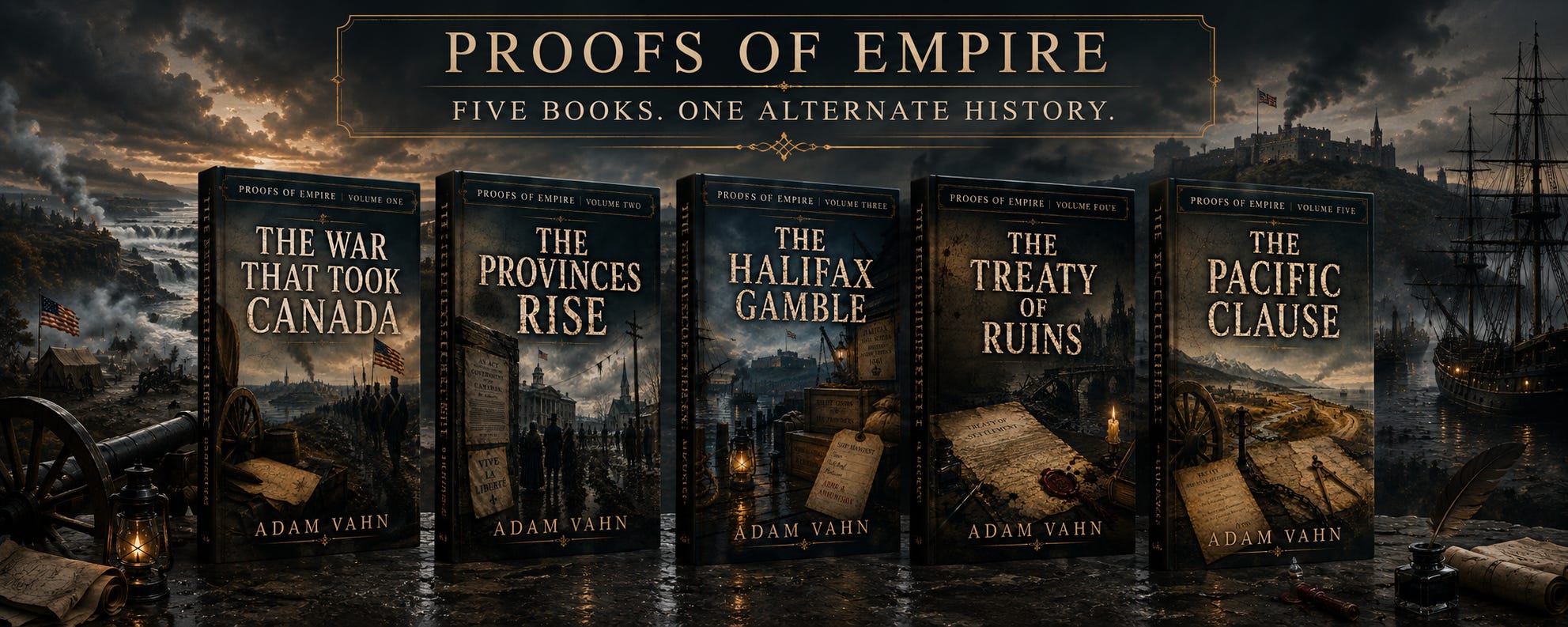
Continue into the world of Proofs of Empire
Explore the complete series and follow Adam Vahn: amazon.com/author/adam_vahn
Volume I: The War That Took Canada • A republic enters the War of 1812 unprepared, then discovers that preparation can become appetite. The alternate history of how the United States learned to conquer Canada, and what that first success taught it to attempt next.
Volume II: The Provinces Rise • Conquest has placed British North America under American rule. Holding it is another war entirely, fought through resistance, divided loyalties, occupation policy, and the stubborn refusal of provinces to become lines on Washington’s map.
Volume III: The Halifax Gamble • The struggle moves east, where Atlantic power, naval supply, political nerve, and one dangerous gamble may decide whether the conquered provinces remain American or tear the new empire apart.
Volume IV: The Treaty of Ruins • Armies can seize territory. Treaties decide which wounds become borders. As exhausted governments negotiate, every concession threatens to become the seed of the next war.
Volume V: The Pacific Clause • The final proof is written far from where the first invasion began. Old precedents return, unfinished loyalties collide, and a continental empire must decide what kind of peace it has actually built.
Proofs of Empire: Parallel Stories. Short fiction running beside the five-volume alternate-history series.