

The Little Red Car
Four old men, a worn cribbage board, and the one car in the county that still knew how to leave.

I tell Walter he has moved his peg twice.
He says he has not.
I tell him I watched him do it.
He says my eyes have not been reliable since the cataract surgery, which is a confident position for a man who has spent the last ten minutes trying to read the six of clubs upside down.
Eddie looks from Walter to me, then down at the board.
“He moved it twice,” he says.
Walter folds his arms. “You weren’t watching.”
“I don’t have to watch. I know you.”
Lou is already laughing, which is one of his gifts. He finds the shape of a joke while the rest of us are still unloading the lumber. Eddie slides Walter’s peg back two holes. Walter moves it forward one and calls it a compromise. That is not how justice works, I tell him. It is exactly how justice works, he says: I only object when the compromise runs against me. He is right, which is the annoying thing about Walter and always has been.
The board he is cheating on is mine. It is a plain thing, maple gone the color of weak tea, three lanes of holes worn soft at the mouths where seventy years of thumbs have found them without looking. Two of the pegs are brass and original. Two are matchsticks I sharpened one year and never got around to replacing, because by then the board had stopped being a thing I owned and become a thing I simply had, like a knuckle or a grudge. I learned the game the winter the country stopped, when I was eleven and nothing in the house lit up anymore. Before that I could not have told you a run from a flush. Before that I was a boy who lived inside a screen. I had a small machine I carried in my pocket and a larger one bolted to the television, and between them they ate every hour I would hand over, which was all of them. Then the screens went dark, the way everything with an opinion went dark that winter, and a widower down the road named Pelham sat me at his kitchen table and taught me to count to thirty-one so I would quit asking him when the power was coming back. It kept my hands busy. It has kept them busy since. I laugh about it now, quietly, the way you laugh at a debt you slipped out of paying. Everything I had been so sure I could not live without turned out to weigh less than a plank of maple, a fistful of pegs, and the plain animal willingness to keep occupied until the trouble passed.
We sit at the round table by the west windows in the common room at Greenhaven, the four of us, on a Thursday, because Thursday is cribbage. Tuesday is euchre, except Walter won’t play euchre because he says it rewards ignorance, and Lou won’t play bridge because he says bridge was invented to end marriages. So it comes down to cribbage, and to the board, and to us.
The snow is heavy enough that the parking lot lights have gone to smudges. Beyond them the county road is almost gone. Now and then a plow passes with an orange beacon turning on the roof, but the road fills in behind it before the sound has faded. Walter looks at it a long moment.
“The road was quieter than this,” he says. “The first winter.”
Nobody asks which winter. There are certain things that don’t need a date attached. You can say the roads, or the quiet, and every one of us past eighty knows exactly what you mean, because we were here for it. We were boys for it. All four of us grew up in this same county, eleven and twelve and thirteen, young enough that the end of the country looked, at first, like a long strange holiday nobody had scheduled. Seventy years on we are eighty-one, and eighty-two, and, in Walter’s case, eighty-three and unbearable about it.
The quiet is the part the young ones can’t picture. They think of snow, and snow softens a place. That quiet was not gentle. The engines had stopped, not for weather, but because the machines that ran them were waiting for a permission that never came, and a road full of cars that will not move makes a silence that leans on you. It felt as though the country had paused mid-sentence to listen for something that was not going to speak.
* * *
Lou sorts his cards and does not look up.
“You remember that little red car,” he says.
Walter sighs. “Not this again.”
“You remember it.”
“I remember you talking about it. That is not the same thing.”
“It becomes the same after seventy years.”
“It was a Volkswagen,” Lou says, to me now, because Walter has stopped being a useful audience. “One of the old ones.”
“A Beetle,” I say.
He points a card at me. “There. Frank remembers.”
My name is not Frank. My name is Harold. Lou has known me for fourteen years, since the week I moved into the room across from his, and roughly half the time he calls me Frank. I have stopped correcting him. It seems to give him something, and at our age you learn to let a man keep the version of you that costs him the least.
“Harold remembers,” he says, without a hitch, and deals.
He deals six to each of us, which is right for two players and wrong for four, and Eddie has to stop him and remind him we are playing partners. Lou looks around the table as though mildly surprised to find three other men sitting at it, then tells Eddie to discard two and consider the problem solved. Walter takes the deck away and does it properly. Lou watches him shuffle with the suspicion of a man observing a street magician, says he doesn’t trust the way Walter shuffles, and Walter says Lou doesn’t trust gravity either.
We play the first hand mostly in quiet. Walter and Lou are partners. Eddie and I are together, which is a burden, because Eddie treats every card I lay down as a window into my character. I take a fifteen with a six, and he tells me I should have saved it. For what, I ask. For later, he says. There is no later in pegging. There is always a later, he says, and Walter drops a queen for thirty-one and Eddie closes his eyes as though I have cost him a son.
The little red car sits down at the table with us. It always does, eventually.
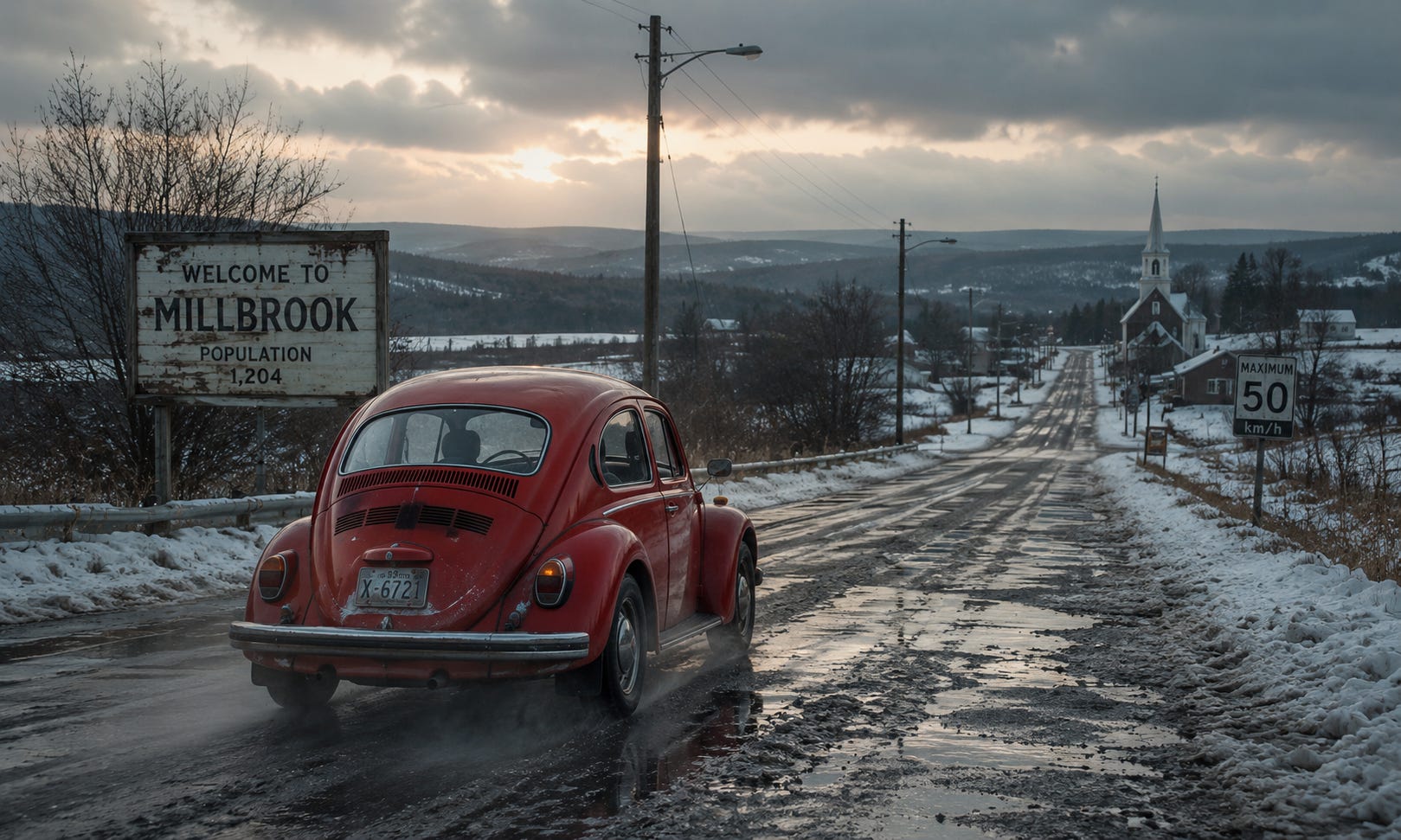
I can see it more clearly than I can see some of the houses I’ve lived in, which is its own kind of joke, since I could not this morning have told you where I left my glasses and found them, in the end, on my own face. The paint gone chalky across the hood. One front fender a shade off from the rest, replaced once or just weathered differently. The rear bumper dipped on the driver’s side. One headlight brighter than the other. And an engine that sounded, when it ran at all, like somebody shaking a coffee can full of bolts. I was eleven. I thought it was the funniest thing I had ever seen on a road.
I should tell you what a road was, that winter, so the car makes sense.
By the time it emptied out, nearly everything on it that could make its own decisions had decided not to. That is the part we understood wrong as boys and understand right as old men. The machines had not broken. That was the whole trouble. They were working exactly as designed, doing what they had been told, which was: when you are not certain, do not move. Cars waited for route clearance. Freight waited for depot release. Ambulances waited for patient authorization. Pharmacies waited for a license check that came back expired at midnight, and the button that would have cleared it had been built so that no one person could press it alone, which turned out to mean no one could press it at all. Everyone in the county said the same two words at every locked door that winter, the way you’d say a prayer at a bedside. Manual override. It stopped being an instruction. It became a thing you said because there was nothing else to say.
There was always supposed to be a person, somewhere, with the authority to reach past the machine. We had built the whole country so that no single person could. Then we found out the committees couldn’t either.
The machines had not broken. That was the whole trouble.
“I saw it by the interchange,” I say. “First time. Down near the feed store.”
Lou snaps his fingers. “Yes.”
“You did not,” Walter says. “You said the feed store last time. The time before you said the interchange.”
“Both. It’s the same stretch of road.”
“Now it’s both.”
“It was near the feed store,” I say, “because I was at the feed store, because that’s where my father was, because Marvin sent him up the ladder.”
The table goes quiet in a different register, and Walter’s face changes, because we all remember Marvin.
Marvin ran the feed store, and my father worked for him, and I was eleven and mostly underfoot. When the warehouse locked, its panel by the loading bay lit a yellow bar that read PRESERVATION MODE, and nobody could say what was being preserved, since the seed was going damp and half the fertilizer sat outside under tarps. Best anyone figured, it was protecting its own inventory records from unauthorized movement: it locked the doors to keep the numbers tidy while the goods spoiled on the floor. Marvin was fifty and stubborn and climbed a ladder to reach the manual release above the door, the release the panel swore existed, and he slipped on the third rung. The ambulance came fast. That surprised us. Its doors would not open when it got there. That did not surprise us at all. They got him out through the side. He lived. Married the physiotherapist.
Walter deals the next hand. I throw a good ten to the crib and Eddie makes a sound through his nose. That kind of thinking, he says, is why you never owned a garage. I never wanted one, I tell him. Exactly, he says, as though he has proved something.
Eddie owned a garage for fifty years. Before that his father owned it, and before that it was just the building where Eddie learned there was nothing on a road he couldn’t take apart. That winter Eddie was twelve and the garage was his father’s, and his father kept the side bay open after the registration network stopped verifying parts and the insurance platform suspended the business because its risk score would not update. People brought in anything that still moved on its own stupid power. Lawn tractors. Farm trucks. Two motorcycles. A delivery tricycle with a dead battery.
The red car came to the garage too. Eddie is nearly sure.
“That was not the same car,” Walter says.
“It was red. It was a Beetle.”
“There were many red cars. There were many Beetles.”
“Not running there weren’t,” Lou says, and Eddie points at him like a lawyer who has found his witness.
Here is the thing Eddie remembers, and it costs him, because he keeps machines better than faces now. He can strip a carburetor in his head, blindfolded, seventy years cold, but the man who drove the car has gone to a smudge, and Eddie has never once in his life made peace with a part he couldn’t name. The driver wanted a fan belt. Or a fuel line. He can’t get it back, and it gnaws. A skinny man, maybe forty, both hands flat on the workbench while Eddie’s father dug through old stock. Tired. Not scared. Past scared. You knew that look by then. Fear moves; fear is busy. This was the thing that comes after, when a person has run out of the energy it takes to be afraid and just stands at your bench and waits.
The man asked what he owed. Eddie’s father told him to take it.
“Generosity from the Fosters,” Walter says. “That establishes the seriousness of the emergency.”
“He was generous.”
“He charged my father forty dollars to look at a fan belt.”
“It needed looking at.”
“He looked at it. He said, ‘Yes, that’s a fan belt.’”
“And was he wrong?”
Lou is wheezing. I catch Eddie smiling down into his cards, and the story bends away from the car the way our stories always do. You start with a red Volkswagen and end up near a turkey, because nothing at our age travels in a straight line except regret, and even that slows down after a while.
* * *
The turkey is Lou’s, and Lou has been waiting.
“First time I saw the car,” he says, “I was walking home with a frozen turkey under my coat.”
Walter rubs his forehead. “Why was the turkey under your coat?”
“Because I didn’t want anyone to see it.”
“You stole it.”
“I rescued it. Store had been closed three days. Freezer was off. That bird was going to spoil.”
“Where was it?”
“Loading ramp behind the grocery. Which,” Lou says, with great dignity, “was in preservation mode.”
He was twelve. He had a thawing turkey inside his coat and both arms crossed over it, walking down the middle of a county road because there was no traffic to walk to the side of, and he heard that little engine come up behind him, rude in all that silence. It came around the bend red as an old barn, one headlight bright and one dim, and the man had both hands on the wheel and nothing on the dash. No screen. No route light. No band on his wrist. Just a man and a car, leaning forward over the wheel like the car needed the encouragement.
“You saw all that with a turkey up your shirt?” Eddie says.
“I had time. The thing was not fast.”
“It was fast enough,” I say, and I mean it.
Because I saw it on the interstate ramp, the day it went up onto the closed road, and that is the picture I have carried seventy years, worn smooth as the board under my thumb. The ramp was lined with cars that had simply stopped where the system lost its nerve. New sedans. Delivery vans. A municipal truck, one of the big ones, the plow, no, the salt truck, orange, dead where it sat. Some had their hazards going. Some had put messages up across the glass for anyone who cared to read them.
REMAIN WITH VEHICLE.
MOVEMENT GUIDANCE LIMITED.
PLEASE CHOOSE A VERIFIED DESTINATION.
And the red car went up between them, rattling and coughing, its little engine sounding indecent in all that expensive quiet, and it did not stop, because it had nothing in it capable of deciding to stop. It could not be told to hold for review. It did not know the words. It went past a line of machines worth more than the houses our fathers owned, and it just kept going, and the driver did not wave and did not look like a hero. He leaned over the wheel and coaxed a sick engine up a forbidden ramp, and we stood at the fence and laughed.
Not because it was funny. Because sometimes foolishness gets so complete that laughing is the only sane answer left.
“All those smart cars,” Lou says, “and the stupidest one was the only one on the move.”
“It wasn’t stupid,” Eddie says. “It was simple. A dumb machine fails and hides it. A simple machine fails and tells you what broke.”
“That sounds rehearsed,” Walter says.
“I had fifty years to rehearse it.”
Marisol comes past the doorway with a tray of paper cups.
“No coffee after seven,” she calls, not slowing.
“We’re drinking tea,” Walter says.
“You’re drinking coffee out of the teapot.”
Walter waits until her footsteps fade down the corridor. “Authoritarianism,” he says.
“You ran a high school for thirty years,” I remind him.
“That was structured guidance.”
Walter did run the high school, later, after he grew up, and I have always thought it was no accident. His father sat on the county’s advisory board that winter, and Walter came up in a house where the language of the collapse got spoken at the supper table before the rest of us heard it on the road. He knew the names of the systems the way other boys knew the names of ballplayers. Gridmind, for the power. The one behind the pharmacies and the benefit desks, the Clearinghouse, which he still says like a swear word. He was the only one of us who understood, at thirteen, that the trouble had names, and that the names would outlast the men who chose them.
“The county sent the board a list of priorities,” he says, dealing. “Hospitals. Water treatment. Shelters. Fuel depots. A perfect list. That was the problem. The systems could not agree which building qualified under which line of it. The shelter had food allocated to it but the warehouse could not release the food, because the shelter’s temporary address had not, and I am quoting a grown man who came to my father’s door near tears, propagated.“
“So the board asked for the override,” I say.
“Everyone asked for the override. My father asked twice a day. The administrator, whatever the man’s name was, it has gone from me and it bothers me more than it should, told him the request had been escalated.”
“To who?”
“That,” Walter says, “was the difficulty.”
Marisol comes back and sets four paper cups in front of us. “Tea,” she says.
Walter lifts the lid and smells it. “This is coffee.”
“It identifies as tea after seven.”
Lou laughs so hard he has to put his cards face down on the table. Marisol waits him out, sets a plate of cookies between us, says one each, and when Eddie counts six and objects, tells him two are hers and she is protecting inventory. She is gone before Walter can build a case. Lou takes two. We let him.
The cards go on, and the county comes back around us the way it does, one man laying down a memory the way he lays down a card, none of us holding enough of it alone. We remember names written on cardboard where the screens had quit. We remember the pharmacist under her own awning with a paper ledger and a shoebox, handing medicine to the people she knew by face, because the system behind the locked door insisted her license had expired at midnight and would not take her word for who she plainly was.
And we remember the children on bicycles riding down the middle of the interstate, because that was us. There is no image of that winter more famous now, and I was in it, pedaling down four empty lanes that had carried the whole weight of the country the week before, ringing a bell at machines that could not hear it. We thought we’d been let out of school forever. We did not know we were riding through the middle of the largest thing that would ever happen to us.
We remember the first night the streetlights went dark and the stars came back over the town. Lou remembers them as beautiful. Walter remembers them as a grid failure. They are both right. That is more or less the whole argument, and we have been having it for seventy years.
* * *
The game reaches ninety before anyone thinks to check the board, and when we do check it none of us can agree how we got there, so we read the story backward out of the pegs, the way we read the winter backward out of each other, and we call the total close enough. Walter and Lou are ahead by four. Eddie calls it a conspiracy. Lou says conspiracy takes planning, which clears him on the merits.
“Last hand,” Walter says.
“You said that two hands ago.”
“I was younger then.”
I look at my cards. Two fives, a six, a seven, and a pair of kings. I throw the kings into Eddie’s crib. He looks at me.
“What?”
“Nothing,” I say.
“That means something.”
“It means I’ve made my peace with who you are.”
Lou is watching the road again, and I know before he opens his mouth that we have not reached the last of the red car.
“I saw it once more,” he says. “This part’s new.”
“That is what worries me,” Walter says.
“It was after things had started to move a little. Not right. Just moving. A few trucks. Buses on some of the routes. A checkpoint out at the county line, with men standing around it arguing over whose road it was now, because by then the road had come loose from everyone who used to own it and nobody had thought to write down who got it next. I was at the clinic. My mother took me. I don’t remember for what.” He frowns. “The doctor was, Han, Hale, something with an H. I had it a minute ago.” He turns his cards face down. “I remember the doors. They kept locking and unlocking on their own, because the system couldn’t make up its mind whether the building was open. Every time they unlocked, the whole line under the awning stepped forward. Every time they locked, the line stepped back. Forward and back, all afternoon, a line of sick people doing a dance nobody was calling.”
I remember that too, or I remember a door like it. There were a lot of doors like it.
Lou says the red Volkswagen came down the road with mud up the sides and a bundle tied to the roof.
“What bundle?” Eddie asks.
“Blankets. Or clothes.”
“Could’ve been anything.”
“Yes.”
“Same driver?”
“I don’t know.”
“Then how do you know it was the same car?”
Lou smiles, and I have been waiting fourteen years to hear him give the honest answer, and tonight he gives it.
“I don’t.”
Nobody says anything for a moment, because it is the truest thing he has said all evening, and we all know it.
Memory wants a pattern, and old men want one more than most. We tie loose events into a story because a story is lighter to carry than a box of facts that don’t touch. Maybe there was one red Beetle. Maybe there were five. Maybe we have braided three strangers’ cars into a single legend because the legend is better company. Between the four of us we have one whole car and not one whole memory, and we have been laying our pieces on the table for seventy years the way we lay down a hand, each holding a few, none holding enough, making between us something none of us could make alone. It does not matter the way it once might have. What matters is that something moved, once, when the country had forgotten how, and four boys were standing where they could see it.
“There was a child in the back seat,” Lou adds.
Walter sighs. “You’ve added a child.”
“I remembered a child.”
“Boy or girl?”
Lou considers. “Small.”
“That is not a sex.”
“It was dark in the car.”
“You said it was daytime.”
“I said the doors were opening and closing. I did not specify the hour.”
Eddie starts to laugh, and I go with him, and Walter tries not to, which is fatal, because when Walter tries not to laugh his glasses slide down and the laugh gets him from underneath like a cough. Lou sits there pleased as a cat, cards to his chest. Mrs. Cormier raises one finger from the puzzle table across the room, and we bring it down to a simmer, and hold it for all of ten seconds, until Eddie asks whether the turkey was still under Lou’s coat, and it goes up again, and Marisol comes back to make sure nobody has hurt himself.
She stands behind Lou’s chair with a hand on his shoulder. “What’s funny?”
“Nothing,” Walter says. “That’s the problem.”
“The roads were empty,” Lou tells her, wiping his eyes.
Marisol looks at the snow past the glass, the road already gone smooth under it. “They’re empty now.”
“Not like then,” Lou says. He waves a hand at the cards, at the window, at the four old reflections the dark has hung in the glass. “Then, everything stopped because nobody could make the machines say yes. And that little car went by anyway.”
Marisol looks at the cribbage board as though it might explain him. “And the car?”
Lou’s smile comes back, slow and satisfied, the smile of a man delivering the only line he has ever needed.
“The car didn’t know how to ask.”
She nods like he has said something medically useful. “Five more minutes.”
“We’re eighty-two years old,” Eddie says. “You can’t give us a bedtime.”
“Ninety-one,” Lou says.
“You are eighty-two, same as me,” Eddie says.
“He’s been ninety-one since the day he turned eighty,” Walter says, not looking up. “He started adding years the week the big numbers finally began to impress the aides.”
“Depends who’s asking,” Lou says, and does not give up the ninety-one, because it is his now the way Frank is mine.
Marisol leaves. Walter turns the starter card, a five, and watches the snow a moment longer than the card needs. “They called what came after a peace,” he says, to no one, in the voice he keeps for the supper table in his head. “I never met a man who felt he had won it.” Then he taps the board, because the game is the game, and we go on.
Eddie looks at his crib, then at me, and his face gives a little.
“You threw me two kings.”
“I did.”
“That may be the first intelligent thing you’ve done all night.”
“Play your card.”
So we play. The count climbs, fives and tens and fifteens, pairs and runs and corrections. Walter moves the wrong peg and denies it. Eddie tells me I should have saved the seven, and I tell him there’s always a later, and outside the snow keeps filling in the road until it looks like no one has ever driven it or ever will.
For a second, under all of it, I can hear that engine again, faint and uneven, coming around a bend where nothing else was moving. Maybe I saw it. Maybe Lou did. Maybe Eddie’s father fixed it. Maybe not one of us has a single detail right. But I remember how we laughed when it went by. I remember that much. The country had gotten too clever to move, and there went that ridiculous little car, rattling down an empty road as though no one had bothered to tell it the future had been called off.
Eddie lays his last card.
“Thirty-one for two. That puts us out.”
Walter studies the board. “You were behind by four.”
“Not anymore.”
“I want a recount.”
“You always want a recount when you lose.”
“I want accuracy.”
“You moved your peg twice at the start.”
“I did not.”
I lean back and look at the three of them. Old Walter, still correcting the world one supper table at a time, still cheating at a game he does not need to win. Old Eddie, still fixing everything within reach and half the things beyond it, still hunting a driver’s face down a hallway seventy years long. Old Lou, still finding a reason to laugh in a room where the reasons are running short, still calling me Frank because Harold costs him more. And me, the boy who lived inside a screen, trying to sort out which parts of that winter happened and which parts only became true because we have said them to each other for seventy years, my thumb resting in a worn hole on a maple board that has outlasted every machine I was ever afraid to live without.
The snow keeps falling. The road stays empty. Lou starts to shuffle for another game. Walter says we agreed the last one was the last one. Lou says he doesn’t recall agreeing to anything.
Eddie tells him to deal.
So he does.
“The Little Red Car” is a story from the world of The Manual Override Trilogy by Adam Vahn.
The men at the cribbage table were boys when the systems stopped saying yes, and they never did learn the driver’s name, or the car’s. Readers of the trilogy will. Her name is Greta, a faded red Beetle with a sulky carburetor and one headlight brighter than the other, and the tired man leaning over her wheel is Mark Ellison, who could still move for one reason only: his car was too old to ask permission.
What was happening at the center of the country while four boys stood at a fence and laughed is the subject of The Systems Nobody Controlled, Book One of the trilogy, from Iron Road Press. The systems were never broken. That was the trouble. They were doing exactly what they had been told, and by the time it mattered, there was no one left with the authority to tell them to stop.
If you want to know who was driving, start with Book One. Subscribe to follow the trilogy, and share this with the person who still keeps something around that runs without asking.
https://www.amazon.com/stores/Adam-Vahn