

The Machinery of Catastrophe
Barbara Tuchman’s The Guns of August and the terrible momentum of systems

There are history books that explain what happened.
There are rarer books that alter the way you understand how anything happens.
Barbara Tuchman’s The Guns of August belongs to the second category.
It is ostensibly a history of the opening of the First World War: the decisions made in European capitals, the armies placed in motion, the invasion of Belgium, the battles along the frontiers, and the desperate weeks before the German advance was halted at the Marne.
That description is accurate. It is also inadequate.
Tuchman did not merely write about generals, monarchs, ministers, and armies. She wrote about systems acquiring momentum. She wrote about people who retained the authority to issue orders while gradually losing the ability to control what those orders would do.
That distinction has stayed with me.
It has shaped how I think about governments. It has shaped how I think about institutions. It has shaped the kind of fiction I write.
Most of all, it has made me suspicious of the comforting idea that catastrophe must be deliberately chosen.
Sometimes nobody chooses the catastrophe.
They choose the timetable.
They honor the commitment.
They protect the alliance.
They follow the plan.
They refuse to appear weak.
They make the reasonable decision available to them at that particular hour, and then discover that all the reasonable decisions have assembled themselves into something monstrous.
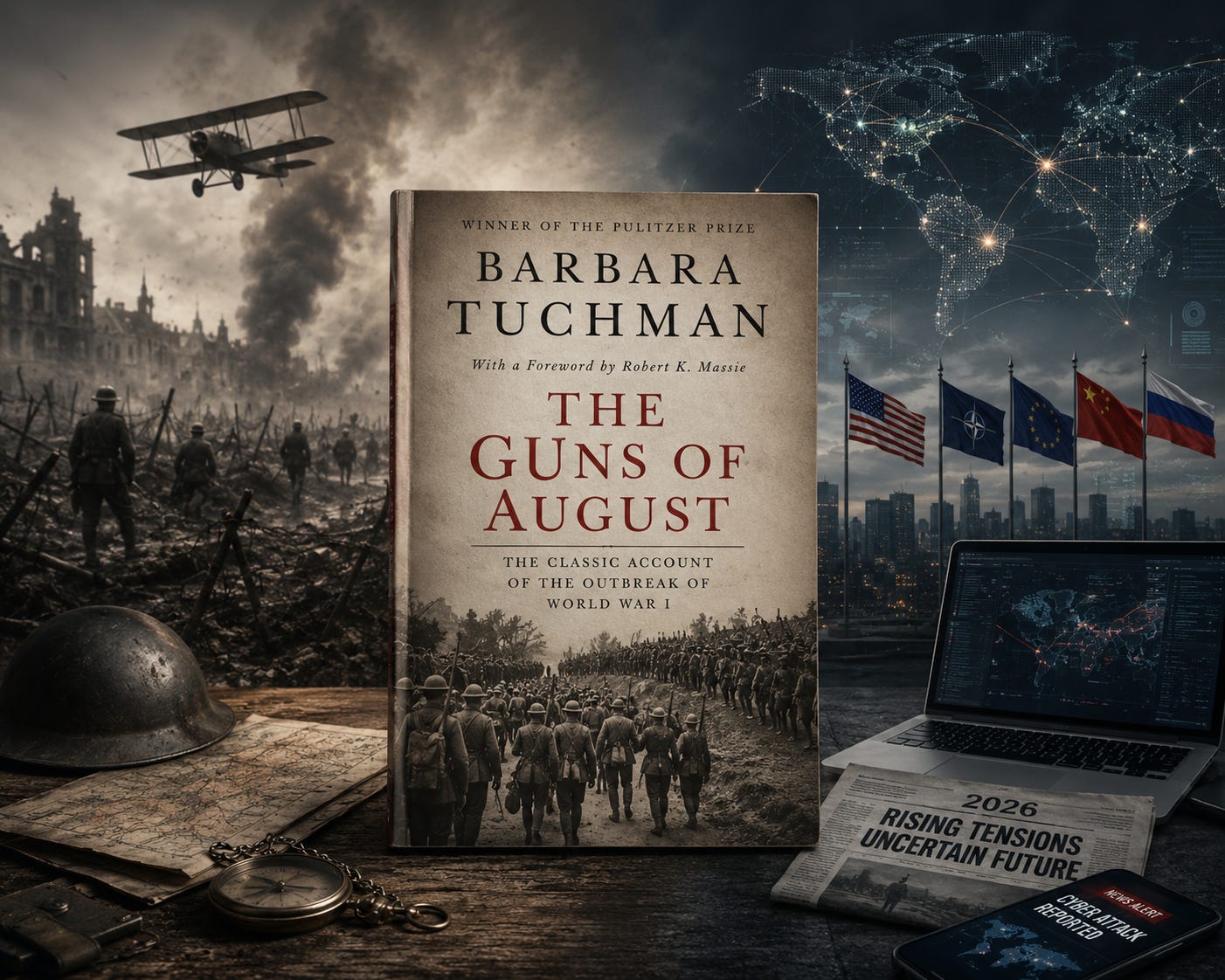
A war built from obligations
The popular memory of the First World War often begins with an assassination.
A young man fires a pistol in Sarajevo. An archduke dies. Europe descends into war.
That version has the advantage of simplicity. It gives history a trigger, a villain, and a clean line between cause and effect.
Tuchman’s account is more unsettling because it shows how much machinery had already been constructed behind the trigger.
Europe in 1914 was bound together by alliances, military schedules, railway plans, diplomatic assurances, inherited rivalries, mobilization procedures, and assumptions about what every other nation would do. Each government believed it had room to maneuver. Each discovered that much of its freedom existed only on paper.
Mobilization was not merely preparation for war. Under the logic of the era, mobilization could itself make war more likely. Railway schedules had been written. Troop movements had been calculated. Supplies had been assigned. Plans depended upon speed, and speed punished hesitation.
Once one country began moving, another faced pressure to do the same.
Waiting became dangerous.
Caution could be interpreted as weakness.
A defensive measure could appear offensive from the other side of a border.
The system did not need to become conscious. It did not need to hate anyone. It simply needed every participant to behave according to the incentives placed before them.
That is the part of The Guns of August that has never left me.
The machinery worked.
That was the problem.
Tuchman’s gift
Barbara Tuchman wrote history with the instincts of a novelist, but not by turning history into fiction.
She understood scene, character, timing, contradiction, and the revealing detail. Her political leaders and generals do not enter the book as marble figures bearing summaries of their policies. They arrive with habits, prejudices, private certainties, professional jealousies, and fatal limitations.
They are not reduced to fools.
That would have made the story less frightening.
Many were intelligent. Many were experienced. Many understood portions of the danger. They were simply trapped inside institutions that divided knowledge, narrowed choices, rewarded confidence, and treated revision as weakness.
Tuchman had a particular eye for the distance between appearance and reality.
A plan might be elegant in a ministry and ruinous on a road. A doctrine might appear decisive on a map and collapse when it encountered exhausted soldiers, frightened civilians, broken communications, missing supplies, or an enemy who declined to behave as predicted.
This is where her prose becomes more than decoration.
She writes with elegance, but elegance never softens the disaster. It sharpens it. Her control of language allows the absurdities and contradictions to stand in full view. The reader can see the grandeur of the uniforms, the certainty of the declarations, and the administrative neatness of the plans.
Then the trains begin moving.
Tuchman knew that history is often most revealing when institutions are forced to meet the physical world.
The memorandum meets the railway platform.
The doctrine meets the bridge.
The timetable meets the refugee column.
The map meets the mud.
The illusion of control
One of the reasons The Guns of August continues to matter is that modern society has not escaped the systems Tuchman described. We have multiplied them.
Our systems are faster, more interconnected, and more dependent upon processes few individuals fully understand. Finance, transportation, power, communications, logistics, public health, military command, automated decision-making, and international trade are all bound together by layers of agreements and technical dependencies.
We speak constantly about control.
We have dashboards, models, forecasts, alerts, simulations, and live feeds. We possess more information than the governments of 1914 could have imagined.
Information, however, is not the same as judgment.
Visibility is not the same as control.
A government may know that a system is under strain without possessing a politically acceptable way to relieve it. An institution may recognize a danger while remaining unable to act because responsibility has been divided among departments, jurisdictions, contractors, allies, regulators, and software.
Everyone may be aware of the problem.
Nobody may possess the authority to stop it.
That is not a failure outside the system. It is a failure produced by the system.
Reading Tuchman in 2026
It is difficult to read The Guns of August in 2026 without feeling the century narrow.
The comparison should not be taken too literally. Europe is not standing in July 1914 with different flags pasted onto the map. Historical analogy becomes dangerous when it is treated as prophecy.
The value of the comparison lies elsewhere.
We live once again in an age of hardened alliances, economic pressure, military expansion, technological competition, territorial disputes, information warfare, and governments attempting to demonstrate resolve without triggering consequences they claim not to want.
Each action arrives with an explanation.
A deployment is defensive.
A sanction is corrective.
A tariff is leverage.
A weapons system is deterrence.
A cyber operation is proportionate.
A military exercise is routine.
An alliance commitment is stabilizing.
From inside each government, the decision may appear limited and rational. From the outside, the same decision may look like preparation, encirclement, escalation, or an ultimatum.
The danger is rarely that leaders openly desire the worst possible outcome.
The danger is that they believe they can approach it safely.
They assume the other side will understand the signal.
They assume the escalation can be calibrated.
They assume economic pressure will remain economic.
They assume military readiness will prevent military action.
They assume automated warnings, surveillance systems, intelligence assessments, and command structures will give them enough time to reconsider.
In 1914, nations discovered that their plans had consumed much of their freedom before the fighting began.
In 2026, our plans can move at machine speed.
That should make us more cautious.
It often seems to make us more confident.
The modern faith in systems
The systems in my own fiction are not sentient villains. They do not awaken, develop ambitions, or decide that humanity is obsolete.
They do what they were built to do.
That idea owes something to Tuchman.
The horror in The Guns of August does not require an evil intelligence coordinating events. There is no hidden machine beneath Europe directing the generals. There are only plans, incentives, institutions, obligations, reputations, and people who cannot find a safe place to stop.
A railway timetable has no ideology.
A mobilization order has no emotion.
An alliance treaty cannot feel fear.
Yet each can restrict the decisions of people who do.
That is far more interesting to me than the fantasy of a machine suddenly turning against its creators. The more plausible danger is that human beings will construct systems that faithfully execute yesterday’s assumptions after the world has changed.
We tend to imagine control as a switch.
Tuchman presents it as a diminishing resource.
At the beginning of a crisis, governments possess choices. Each choice closes others. Each public commitment raises the cost of retreat. Each movement creates pressure for a countermovement. Each hour spent protecting credibility makes compromise more humiliating.
Eventually, leaders may still be issuing commands, but they are choosing among outcomes their earlier decisions have already narrowed.
They remain in charge.
They are no longer free.
History without hindsight
Tuchman’s greatest accomplishment may be her ability to restore uncertainty to events whose outcomes we already know.
We know the war will not be short.
We know the Western Front will harden.
We know millions will die.
We know empires will fall and another, even more destructive war will grow from the settlement.
The people in her book do not know any of that.
They possess plans, predictions, prejudices, and confidence. They act within a future that remains invisible to them.
This is one reason the book still feels alive. Tuchman does not allow hindsight to make inevitability look natural. She shows that events were made by people, but not necessarily mastered by them.
History is not a tribunal populated entirely by idiots and monsters.
It is a record of people making decisions with incomplete information while carrying obligations inherited from decisions made long before they arrived.
That does not absolve them.
It makes their responsibility more complicated.
A permanent warning
Some historical scholarship ages because new archives are opened, interpretations change, and later historians revise what earlier writers believed.
The Guns of August should not be mistaken for the final word on the origins of the First World War. No single narrative could carry that weight.
Its permanence comes from somewhere else.
Tuchman captured a recurring human condition: the moment when institutions built to provide security begin manufacturing danger, when plans intended to preserve freedom of action begin eliminating it, and when leaders confuse continued motion with control.
That condition did not end in 1914.
It did not end with the twentieth century.
It has migrated into new systems.
The trains are faster now. Some are made of capital, data, treaties, algorithms, supply chains, and automated warnings. They do not announce themselves with steam or gather beneath the iron roofs of great European stations.
They still run on timetables.
They still carry assumptions.
They can still depart before anyone has decided exactly where they ought to go.
That is why I continue to return to Barbara Tuchman.
She did not simply explain how a war began.
She explained how human beings can build a machine from promises, plans, pride, fear, and procedure, then stand before it in genuine astonishment when it begins to move.
Rating: ★★★★★