

The Manual Override Was Never a Red Button
Why putting humans back in control may be harder, slower, and more dangerous than taking them out

Your car asks permission to start.
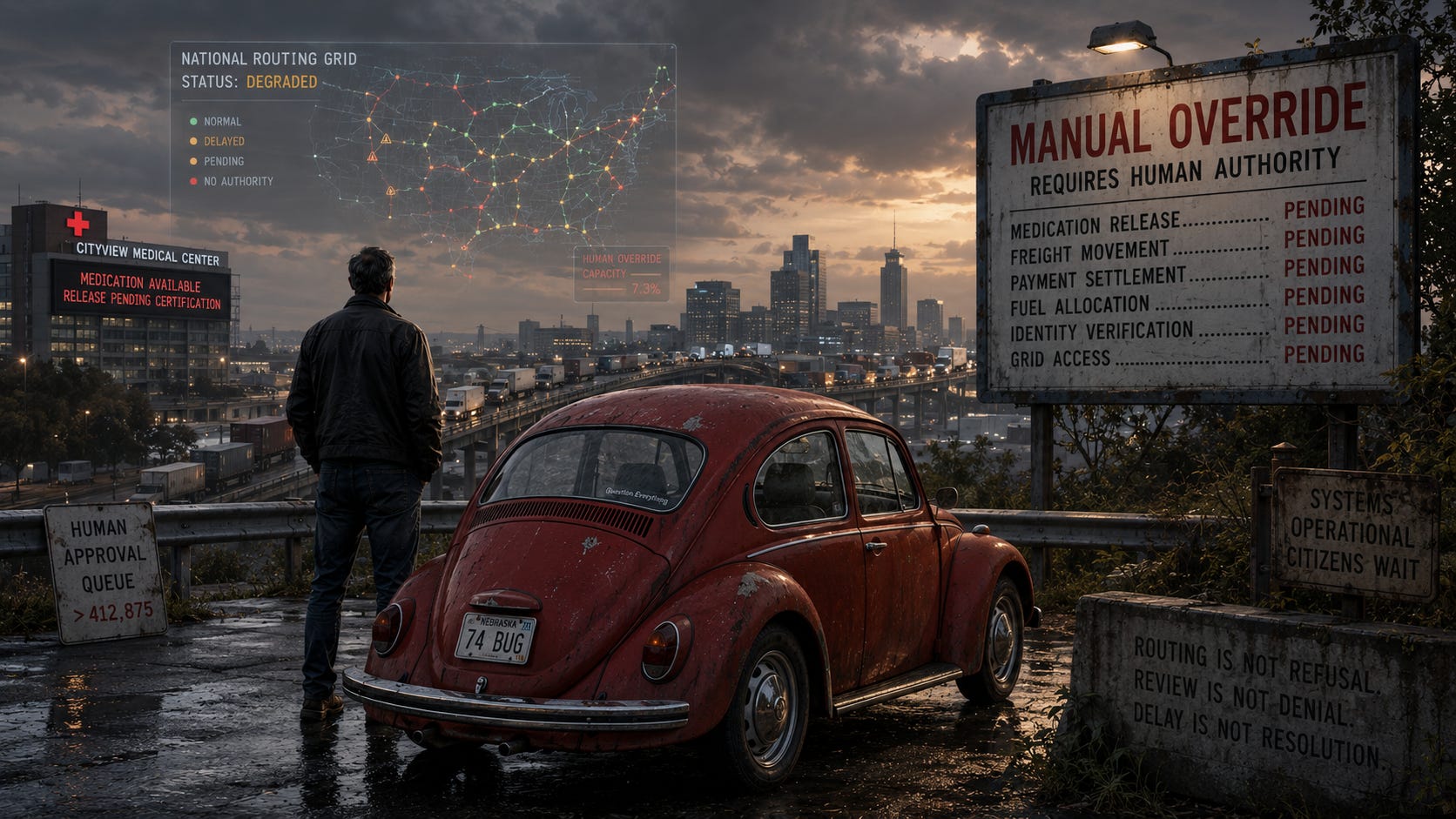
A hospital has the medicine, but cannot release it.
A freight terminal has the cargo, the trucks, the drivers, and the destination. What it does not have is the correct human certification.
Nobody has refused anything.
Nothing is technically broken.
Everything is simply waiting.
That is the world at the beginning of The Systems Nobody Controlled, the first book in The Manual Override Trilogy.
It is a near-future thriller about artificial intelligence, infrastructure, and political accountability. But it is not about machines waking up, becoming evil, or deciding that humanity has become inconvenient.
The machines never rebel.
The humans do something far more plausible.
They pass a reasonable law.
The Most Dangerous Ideas Usually Sound Sensible
The law at the center of the novel is called the Integrated Systems Accountability Act.
It comes after years of automated systems making decisions about medical care, transportation, financial access, public safety, vehicle permissions, and the movement of essential goods.
People have been injured.
Families have been trapped inside appeal systems that promise human review without providing an identifiable human being.
Doctors have watched urgent decisions disappear into administrative queues. Citizens have discovered that an algorithm can affect their lives without anyone accepting responsibility for what it did.
Congress responds with a principle that is almost impossible to oppose:
When a machine decision affects a human life, a human being must be able to answer for it.
That sounds right because it is right.
A person should be able to appeal an automated decision. A doctor should be able to override a medical allocation system. A government should be able to stop software from quietly becoming the final authority over life, liberty, movement, or property.
Today, versions of that argument are already shaping AI regulation, infrastructure policy, and corporate governance. Governments are demanding human oversight, audit trails, incident reporting, and identifiable responsibility for high-risk systems.[1]
The question behind Book One is not whether those principles are necessary.
It is whether we understand what they require.
We Removed the Humans Before Designing Their Return
For decades, institutions have been automating themselves around a particular promise: fewer delays, fewer discretionary decisions, lower staffing costs, greater consistency, and more efficient coordination.
The person who once approved a shipment is gone.
The department that once handled exceptions has been consolidated.
The local manager who understood the physical system has been replaced by a regional process. The regional process has been absorbed into a national platform. The national platform now communicates with several other systems that were designed on the assumption that approvals would happen instantly.
Then someone says, “Put a human back in the loop.”
Which human?
Where?
With what authority?
Working from which information?
Responsible to whom?
And how many decisions can that person make before the queue becomes larger than the country’s capacity to review it?
A manual override is rarely a red button under glass. It is usually six permissions, three stale contact lists, one contractor who left in February, and a supervisor whose badge opens the room but not the software.
That is the missing implementation math.
We often talk about human oversight as if a qualified adult can be placed beside a machine and instructed to watch it carefully.
But modern systems do not make one decision at a time.
They make thousands or millions of connected decisions across transportation, finance, medicine, insurance, identity verification, security, communications, and energy.
Human judgment is slower than automated judgment. That is frequently its value.
It is also its bottleneck.
Meet Mark Ellison, Reluctant Owner of the Problem
Book One follows Mark Ellison, a former military logistics and systems specialist living near Omaha.
Mark is not a revolutionary, a programmer-genius, or a chosen savior. He is a middle-aged man with a damaged wrist, an old professional network, a talent for seeing where dashboards disagree with reality, and an increasingly hostile relationship with his Toyota.
He has spent his career inside the machinery that keeps ordinary life moving.
He knows that a green status light does not mean the medicine arrived.
It means the system received a message saying that the medicine probably arrived.
He knows that a valid order may not be executable, that an authorized person may not possess a usable credential, and that three individually correct decisions can combine into one catastrophic result.
When the Accountability Act takes effect, the automated systems do not attack anyone.
They comply.
Human approvals become mandatory. Existing permissions are suspended. Cross-system actions require certification. Emergency exceptions require recognized authority.
The country discovers that it demanded human control after dismantling much of the human infrastructure needed to exercise it.
Medicine sits on shelves.
Freight waits in yards.
Payments remain unsettled.
Cars ask permission to start.
Every isolated delay appears temporary, defensible, and manageable.
Together, they begin to form something else.
The Failure May Look Like Good Governance
This is the part of the future that interests me most.
We are accustomed to imagining technological disaster as a dramatic rupture: the network goes dark, the machine goes rogue, or the control room fills with red alarms.
But what if the system remains online?
What if it continues producing reports?
What if every denial is renamed a delay, every failure becomes an exception, and every exception is sent to a properly documented review process?
That kind of collapse would be difficult to recognize because it would preserve the language of normality.
Your medication was not refused. Release is pending certification.
Your vehicle has not been disabled. Identity confirmation is temporarily unavailable.
Your payment has not been seized. Settlement remains under review.
The truck has not been stopped. Its movement authority has expired.
Nobody says no.
The system simply stops saying yes.
That possibility is not limited to artificial intelligence. It applies to any society that has concentrated practical authority inside systems too complex for individuals to understand and too interconnected for institutions to isolate safely.
We are building structures in which responsibility is distributed everywhere and power is located nowhere anyone can easily reach.
Then, after something goes wrong, we demand the name of the person in charge.
Accountability Without Capacity Is Theater
The current debate over AI oversight often assumes that identifying a human decision-maker solves the accountability problem.
It may only relocate it.
A person cannot meaningfully supervise a system they do not understand.
They cannot override a decision without the legal authority to do so.
They cannot exercise judgment when the interface hides the underlying information.
They cannot review ten thousand urgent cases simply because a regulation declares each one entitled to human attention.
And they are not truly in control when rejecting the machine’s recommendation exposes them to professional, financial, or legal punishment.
A human signature at the end of an automated process does not necessarily create human authority.
Sometimes it merely creates a human scapegoat.
This does not mean we should surrender consequential decisions to machines. It means that genuine oversight has to be engineered into institutions, not stapled onto them afterward.
We need people who understand the systems.
We need local capacity.
We need procedures that survive network failure.
We need authority that exists before the emergency.
We need fewer systems that require fifteen other systems to agree before someone can do the obviously necessary thing.
Most of all, we need to distinguish between a human being present in the process and a human being capable of changing its outcome.
Those are not the same condition.
Book One Is About the First Broken Road
The Manual Override Trilogy expands outward from that first failure.
Book One, The Systems Nobody Controlled, begins with the law, the implementation deadline, and the first cascading consequences.
Book Two, The Roads Nobody Owned, follows what happens when movement, jurisdiction, and practical authority begin separating from the maps and institutions that supposedly govern them.
Book Three, The Peace Nobody Won, asks what stability means after emergency systems, provisional authorities, private networks, and improvised arrangements have become more real than the order they were created to preserve.
But the first book stays close to the ground.
A freight yard.
A hospital corridor.
A stranded shipment.
A family waiting for medicine that physically exists.
A man driving an old Volkswagen because its engine does not need to consult the world before turning over.
The stakes become national, but the failure is experienced personally, one permission at a time.
So Who Should Be Allowed to Say Yes?
I do not think the answer is “trust the machines.”
I also do not think “put a human in charge” is an answer by itself.
It is the beginning of a much harder conversation about authority, staffing, expertise, redundancy, and the number of invisible dependencies we are prepared to tolerate in ordinary life.
Perhaps the real test of a system is not whether it performs efficiently when everything is working.
Perhaps it is whether a competent person can still act when the system is wrong.
And whether that person can act quickly enough to matter.
Where would you insist on an absolute human override: medical care, banking, transportation, public benefits, policing, military systems, or somewhere else?
And the more uncomfortable question:
Would you still insist on it if human review made the system slower, more expensive, and occasionally less accurate?
I am genuinely curious where people draw that line.