

The Post-Heroic Era
What Remote Warfare May Cost Us Before the Next War Begins

War has always created distance.
The spear extended the reach of the arm. The bow allowed one person to kill another from beyond immediate retaliation. Gunpowder increased that distance again. Artillery moved the source of destruction beyond the victim’s sight, while aircraft carried violence over armies and into cities far behind the front.
Remote warfare is therefore not a complete break from history. It is the latest stage in a process that has been unfolding for centuries.
What may distinguish the present moment is not distance alone. It is the combination of physical distance, technological precision, constant surveillance, automated analysis, fragmented responsibility, and reduced political risk for the side able to fight from afar.
We may be entering what I think of as the post-heroic era of warfare.
That does not mean courage has disappeared. Soldiers, civilians, medics, aid workers, journalists, firefighters, and ordinary families continue to act with extraordinary bravery. Nor does it mean that earlier wars were noble contests between willing combatants. History provides no honest basis for that romance.
The term describes something narrower and more troubling: a form of warfare in which individual courage has less influence over events, personal exposure is distributed increasingly unevenly, and the consequences of violence are experienced most fully by people far removed from the decisions that produced it.
This idea sits at the center of my novel Treated as Hostile: A Post-Heroic War Novel. The book is not an argument against soldiers, nor is it an accusation against civilians trapped within modern conflicts. It is an examination of the systems surrounding them.
Its central question is simple:
What happens when war becomes easier to conduct at a distance but no easier to survive on the ground?
Every Weapon Changes More Than the Battlefield
Major changes in military technology rarely remain confined to tactics. They alter institutions, political calculations, social structures, and the stories nations tell about war.
The spread of firearms did not eliminate swords, cavalry, or close combat overnight. For centuries, old and new weapons existed together. Over time, however, firearms reduced the importance of certain forms of individual martial skill and increased the importance of drilling, supply, manufacturing, and organized volleys.
The warrior did not disappear. He became part of a larger machine.
Industrialization accelerated this process.
Artillery and trench warfare existed before the First World War, but the conflict brought them together on an unprecedented industrial scale. Machine guns, rapid-fire artillery, barbed wire, railways, mass mobilization, and enormous ammunition production helped create defensive systems that could consume thousands of lives for modest territorial gains.
A soldier might never see the artillery crew firing at him. He experienced the weapon as sound, concussion, fragments, collapsing earth, and the possibility of death arriving from beyond the visible battlefield.
The First World War also forced societies to confront psychological injuries that did not fit established ideas of courage and cowardice. “Shell shock” became an imperfect early term for injuries that military culture had not yet learned to understand. Technology had changed the battlefield faster than institutions had changed their understanding of the human mind.
The Second World War widened the battlefield again.
Strategic bombing had precedents in earlier conflicts, including the First World War, but it became a central instrument of warfare during the Second. Aircraft carried destruction deep into national territory. Industrial areas, ports, rail networks, housing, and entire cities became part of the military geography.
The boundary between the front and the home front weakened. A factory worker, railway employee, firefighter, nurse, or child sheltering beneath a city could experience war as directly as many uniformed personnel.
Each technological transition created new military possibilities. Each also produced consequences that doctrine, law, medicine, and public morality struggled to absorb.
We should expect the same from remote and increasingly automated warfare.
Distance Has Become a System
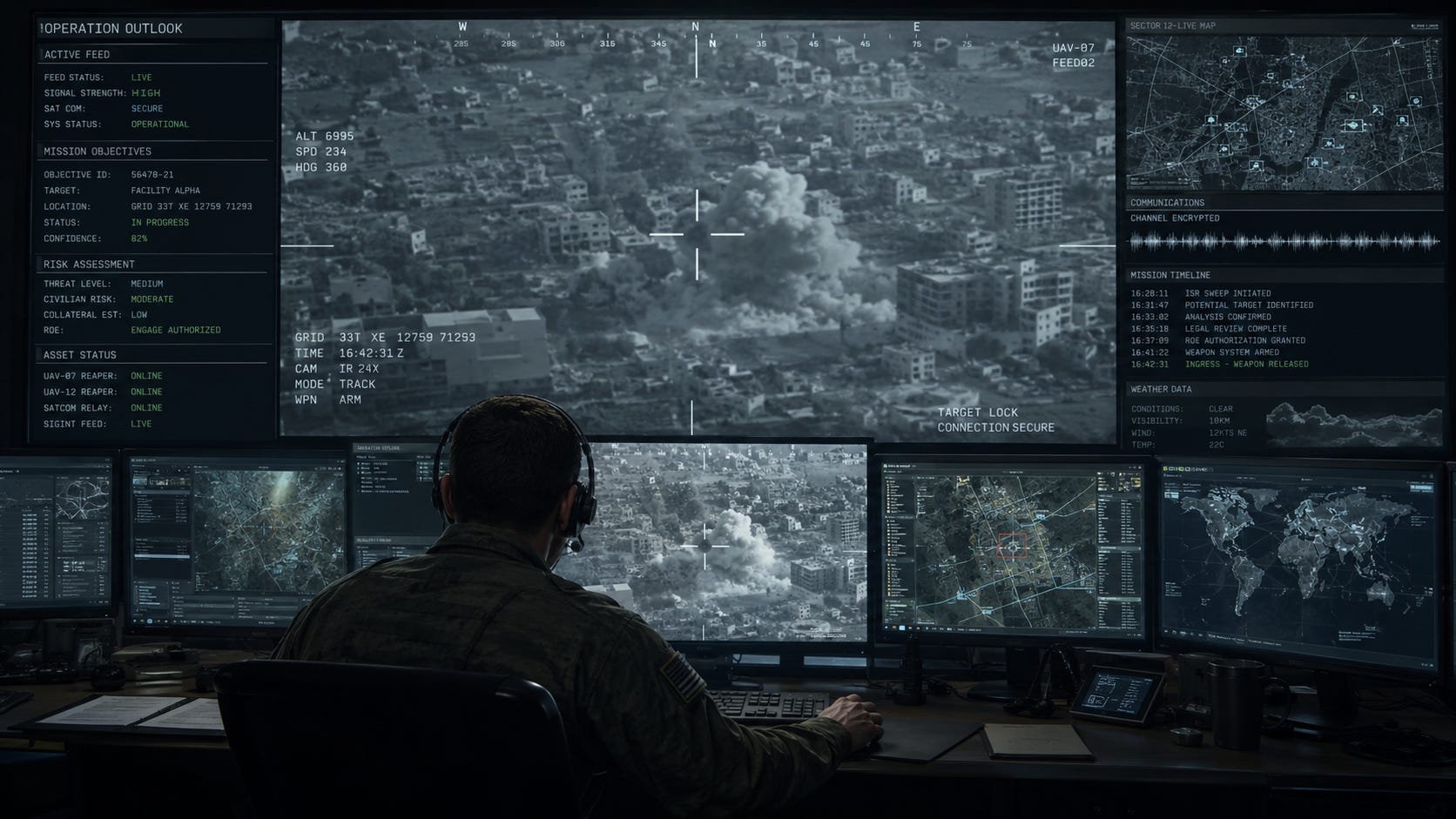
A cruise missile may travel hundreds or thousands of miles before reaching its target. A drone operator may control an aircraft from another region or another continent. Intelligence may be collected by satellites, processed by software, reviewed by analysts, passed through a command structure, and converted into a target package before anyone authorizes a strike.
No single person necessarily sees the whole chain.
One team gathers information. Another interprets it. Someone else evaluates legality. A commander grants approval. An operator releases the weapon. A separate group later conducts a battle-damage assessment.
Each person may perform a limited and professionally defined task. Each may act sincerely, carefully, and within the information available.
The system can still produce catastrophic harm.
This is one of the central dangers of remote warfare: responsibility does not vanish, but it can become divided into pieces small enough that nobody feels responsible for the complete result.
The analyst saw a pattern.
The commander saw a military objective.
The operator saw coordinates.
The political leadership saw a successful operation.
The family beneath the strike experienced the whole event.
That is not primarily a story about cruel individuals. It is a systemic problem. Modern institutions can separate action from consequence so efficiently that decent people may participate in terrible outcomes without any one of them intending the final shape of the harm.
The Screen Does Not Make War Unreal
It would be both inaccurate and unfair to claim that remote operators feel nothing or face no psychological consequences.
Some drone crews may observe a potential target for long periods. They may watch people enter and leave buildings, learn daily routines, see families nearby, witness a strike, and remain over the location afterward. Unlike pilots who release a weapon and leave the area, remote crews may continue watching as survivors, emergency workers, and relatives arrive.
Their distance is physical, not necessarily emotional.
Remote warfare can therefore create a strange form of mediated intimacy. An operator may know when someone leaves home each morning without ever hearing that person speak. The operator may participate in lethal action during a work shift and then drive home through ordinary traffic.
There is no long journey back from the front. The border between combat and domestic life may be a secure door, a parking lot, and a short commute.
The important question is not whether these veterans will understand the horrors of war.
It is which horrors they will understand, and which will remain outside the camera’s frame.
They may understand the pressure of uncertain identification, the burden of authorization, the monotony of surveillance, the moral injury of a mistaken assessment, or the experience of watching death through a sensor.
They may not experience the smell of a destroyed building, the weight of carrying an injured person, the weeks without clean water, the search for medication after a hospital loses power, or the fear created by a drone that hovers overhead without firing.
These are different forms of knowledge. Neither should be dismissed. Neither is complete.
The Civilian Lives Beyond the Strike
Military analysis often concentrates on the immediate event.
Was the target struck? Was the intended capability destroyed? Were civilian casualties anticipated? Was the damage proportionate to the military advantage expected?
Those questions matter. International humanitarian law requires distinctions between civilians and combatants, precautions in attack, and assessments of proportionality. Remote weapons do not remove those obligations.
But the effects of a strike can travel far beyond the explosion.
A damaged electrical station may interrupt hospital care, water treatment, communications, transportation, refrigeration, and heating. A destroyed bridge may prevent food, medical supplies, or emergency crews from reaching an entire area. Damage to a port may affect fuel and food distribution long after the military operation has ended.
Civilian systems are interconnected. An attack on one part may trigger failures across many others.
The weapon may be precise in the narrow sense that it lands where it was directed. The consequences need not remain precise.
This is visible in contemporary conflicts.
In Ukraine, long-range missiles and drones have inflicted casualties in cities far from the front while attacks on energy, railway, and port infrastructure have disrupted civilian life across large areas. Short-range drones have also become a severe threat in frontline communities, where civilians may be exposed while traveling, evacuating, working, or seeking aid.
In Gaza, the scale of damage to housing, health care, sanitation, transportation, and other civilian systems has shown how quickly the destruction of infrastructure can transform every aspect of survival. The humanitarian effects cannot be measured solely by the number of people killed at the moment of impact. They continue through displacement, interrupted medical care, hunger, exposure, disease, and the collapse of ordinary services.
These conflicts are not identical, and their political and military circumstances should not be flattened into a single comparison. They nevertheless reveal a common feature of contemporary war:
The initial strike is often only the first chapter of the harm.
Civilians Are Not Merely Near the Battlefield
We often say that civilians are “caught in the crossfire.” Sometimes that is accurate. It can also make their suffering sound accidental to the real contest, as though the war occupies one space and civilian life happens to stand too close.
Modern conflict increasingly makes that distinction difficult.
Cities contain transportation networks, communications systems, electrical grids, hospitals, data centers, ports, fuel depots, factories, government offices, warehouses, and housing. Many systems serve both civilian and military purposes. The same road may carry an ambulance, a refugee family, military supplies, and an armed unit within the same hour.
This is sometimes described as dual use. On the ground, however, it means that almost everything sustaining ordinary life can acquire military relevance.
A harbor moves food and civilians, but it may also move fuel or equipment.
A communications tower supports emergency services and families, but it may also transmit military information.
A bridge connects neighborhoods, but it may also carry armed forces.
Once these systems become targets, the battlefield no longer surrounds civilian life. Civilian life becomes part of the terrain being contested.
This is the world of Treated as Hostile.
Its characters do not move through a clearly marked front. They move through roads, shelters, checkpoints, damaged towns, disrupted communications, frightened patrols, improvised defenses, and systems that no longer interpret human behavior reliably.
A family seeking safety may resemble unauthorized movement.
A vehicle carrying supplies may resemble military transport.
A group of wounded people may appear on a sensor as a concentration of bodies.
The machine does not need to hate them. It needs only to classify them.
That is the colder danger.
When Classification Replaces Recognition
Traditional stories of war often rely on recognition. The soldier sees the enemy. The commander understands the battlefield. The hero makes a decision whose moral meaning can be understood by the audience.
Modern war increasingly depends upon classification.
Friendly. Hostile. Civilian. Combatant. Military objective. Dual-use infrastructure. Authorized route. Restricted zone. Acceptable risk.
These categories are necessary. Armies cannot operate without organizing information, and the laws of war themselves depend upon distinctions.
The danger begins when classifications are mistaken for complete knowledge.
A person may be classified according to location, movement, association, clothing, vehicle, communications activity, or proximity to someone else. Software may help filter enormous volumes of surveillance data. Artificial intelligence may assist analysts in recognizing objects, identifying patterns, predicting behavior, or prioritizing potential targets.
Such tools can improve awareness and perhaps reduce certain errors. They can also accelerate decisions, reproduce faulty assumptions, conceal uncertainty beneath technical confidence, and produce more potential targets than human beings can meaningfully investigate.
A machine-generated recommendation may appear neutral because it is expressed mathematically. But every system reflects choices about data, categories, thresholds, and acceptable error.
Technology does not remove human judgment. It can bury human judgment inside a process that appears objective.
The Drone That Does Nothing
One of the most disturbing possibilities in remote warfare is not the drone that attacks.
It is the drone that does nothing.
A drone can hover over a town, a road, or a group of people without revealing its purpose. Those below it may not know whether it is armed, observing, transmitting coordinates, waiting for authorization, or simply passing overhead.
They must still respond.
People change routes. They avoid gathering. They stop assisting others. Parents keep children indoors. Drivers abandon vehicles. Communities reorganize ordinary life around the possibility of sudden violence.
The weapon exerts power without firing.
The sound becomes a warning that cannot be interpreted and cannot be ignored.
This matters because civilian harm is not limited to injuries, deaths, or destroyed buildings. Persistent surveillance and the expectation of attack can create profound psychological distress. Fear becomes part of the environment.
In a post-heroic war, domination may occur through anticipation as much as destruction.
Who Will Remember the Whole War?
Veterans have often played a complicated role after conflict. Some defend the wars in which they served. Others become among their strongest critics. Their authority comes partly from the fact that they were there and witnessed what war demanded.
Remote warfare does not eliminate veterans or their testimony. It may fragment what any one person can witness.
An operator knows the screen.
An analyst knows the intelligence.
A commander knows the authorization process.
A medic knows the wounded.
A civilian knows what happened after the infrastructure failed.
A refugee knows what it meant to leave.
Each possesses a truthful part of the war.
Nobody necessarily possesses the whole.
This raises a difficult political question. Who will challenge the next war if the people whose testimony is most trusted experienced only one tightly controlled section of the previous one?
The civilians who lived through its broadest consequences may be foreign, displaced, politically inconvenient, or dismissed as partisan. The personnel involved in remote operations may be restricted by secrecy or may lack access to what happened beyond the surveillance frame. Political leaders may speak primarily through metrics, objectives, and assessments.
Everyone may hold evidence while the complete human story remains unassembled.
That may be one of the greatest dangers of the post-heroic era: not war without witnesses, but war divided among witnesses who are never placed in the same room.
War Without Political Friction
Remote weapons can offer genuine military advantages. They may reduce danger to personnel, improve surveillance, increase accuracy, and allow more time for some decisions. Protecting one’s own forces is not morally suspect. Governments have an obligation to avoid sacrificing people needlessly.
But reduced exposure can also weaken one of the restraints on military action.
When war requires mass mobilization, visible deployments, large numbers of casualties, and returning coffins, the public cost is difficult to conceal. When force can be applied through missiles, drones, cyber operations, special forces, contractors, and distant platforms, leaders may find it easier to describe military action as limited.
A limited operation may be limited for the state conducting it.
It may not feel limited beneath the flight path.
The danger is not that remote warfare automatically makes governments reckless. It is that it can lower certain political costs while leaving the human costs elsewhere.
Distance can protect the operator while insulating the decision-maker.
Preparing for the Next Transformation
The answer is not nostalgia for an earlier form of war. Hand-to-hand combat was not morally superior. Trenches did not teach humane lessons simply because soldiers suffered inside them. Bomber crews and infantry soldiers could be physically exposed while civilians endured even greater destruction.
There was no golden age when war was honest.
The lesson of history is different.
New military technologies repeatedly develop faster than the laws, institutions, medical systems, ethical frameworks, and public language needed to govern them.
The First World War revealed forms of industrial killing and psychological injury that existing institutions struggled to comprehend.
The Second World War demonstrated that industrial societies could turn entire cities and populations into strategic targets.
The nuclear age forced humanity to consider weapons capable of making traditional victory meaningless.
The present transformation involves remotely operated systems, persistent surveillance, cyber operations, autonomous functions, artificial intelligence, inexpensive drones, and weapons capable of reaching deep into civilian space.
We should not wait for catastrophe before asking what these technologies will do to responsibility, restraint, trauma, political accountability, and civilian survival.
• Weapons reviews must consider not only whether a system can strike accurately, but how it affects the speed and quality of human decisions.
• Military organizations must preserve meaningful human judgment rather than treating it as a final signature on an automated process.
• Legal assessments must account for foreseeable effects on interconnected civilian infrastructure, not merely the structure directly struck.
• Veterans’ care must recognize the unusual psychological burdens of remote participation in violence.
• Public reporting must include consequences after the camera moves away.
Most importantly, societies must resist language that turns human suffering into a technical abstraction.
The Meaning of the Post-Heroic Era
A post-heroic war is not a war in which nobody acts bravely.
It is a war in which bravery may no longer shape the outcome.
A civilian can take every reasonable precaution and still be classified as a threat. A soldier can follow every procedure available and still participate in an outcome nobody intended. A commander can receive more information than any commander in history while remaining unable to see the full human consequences of a decision.
War becomes simultaneously more visible and less understood.
We can watch a strike in extraordinary detail. We can follow a missile through the air. We can see a building collapse from several angles.
What we rarely see is the refrigerator failing at the clinic two days later.
We do not see the water pump stop.
We do not see the family begin walking.
We do not see the child’s infection worsen because the road to the hospital is closed.
The screen captures the explosion. The war continues outside its frame.
Treated as Hostile is my attempt to remain with the people outside that frame. It follows those who are not deciding the war, directing it, or winning it. They are simply trying to cross the landscape it has transformed.
That is where the post-heroic era must ultimately be judged.
Not by the sophistication of the weapon.
Not by the safety of the operator.
Not even by the accuracy of the strike in isolation.
It must be judged by whether the systems we build preserve our ability to recognize the human being at the other end of the decision.
We are not the first generation to face a transformation in warfare.
We may, however, be among the last with the opportunity to examine this one before its assumptions harden into doctrine.
The question is no longer whether warfare will become more remote, more automated, and more dependent upon machines.
It already has.
The question is whether our systems of law, responsibility, memory, and moral judgment can keep pace.
Which consequence of remote warfare (fragmented responsibility, psychological effects on operators and civilians, infrastructure collapse, or the challenge of collective memory) do you see as most urgent to address before the next conflict?
I explore these questions through fiction in Treated as Hostile. If the themes here resonate, I’d value your thoughts in the replies.
Treated as Hostile: A Post-Heroic War Novel is available now in paperback and on Kindle.
https://www.amazon.com/dp/B0H6SDT872
A note on sources
The contemporary examples draw on open reporting. Ukraine’s strikes on energy, rail, and port infrastructure, and the frontline drone threat, are documented in current war reporting and analysis. The Gaza figures on housing, health care, water, and sanitation come from United Nations Office for the Coordination of Humanitarian Affairs situation reports and the World Bank, EU, and UN damage and needs assessment. The historical claims (industrial-scale artillery and shell shock in the First World War, strategic bombing in the Second, the nuclear age) are matters of settled record.